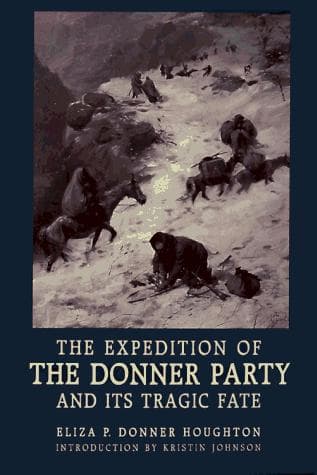
The Expedition of the Donner Party and its Tragic FateHoughton, Eliza Poor Donner
History
The Expedition of the Donner Party and its Tragic Fate
Houghton, Eliza Poor Donner
Donner Party; Overland journeys to the Pacific
The group around my father's wagon were deeply touched by Mr. Reed's
narrative. Its members were friends of the slain and of the slayer.
Their sympathies clustered around the memory of the dead, and clung to
the living. They deplored the death of a fellow traveller, who had
manfully faced many hardships, and was young, genial, and full of
promise. They regretted the act which took from the company a member
who had been prominent in its organization, had helped to formulate its
rules, and had, up to that unfortunate hour, been a co-worker with the
other leading spirits for its best interests. It was plain that the
hardships and misfortunes of the journey had sharpened the tempers of
both men, and the vexations of the morning had been too much for the
overstrained nerves.
Mr. Reed breakfasted at our tent, but did not continue his journey
alone. Walter Herron, one of my father's helpers, decided to accompany
him, and after hurried preparations, they went away together, bearing
an urgent appeal from my father to Captain Sutter for necessary teams
and provisions to carry the company through to California, also his
personal pledge in writing that he would be responsible for the payment
of the debt as soon as he should reach the settlement. My father
believed the two men would reach their destination long before the
slowly moving train.
Immediately after the departure of Messrs. Reed and Herron, our wagons
moved onward. Night overtook us at a gruesome place where wood and feed
were scarce and every drop of water was browned by alkali. There,
hungry wolves howled, and there we found and buried the bleaching bones
of Mr. Sallé, a member of the Hastings train, who had been shot by
Indians. After his companions had left his grave, the savages had
returned, dug up the body, robbed it of its clothing, and left it to
the wolves.
At four o'clock the following morning, October 10, the rest of the
company, having travelled all night, drove into camp. Many were in a
state of great excitement, and some almost frenzied by the physical and
mental suffering they had endured. Accounts of the Reed-Snyder tragedy
differed somewhat from that we had already heard. The majority held
that the assembly had been lenient with Mr. Reed and considerate for
his family; that the action taken had been largely influenced by rules
which Messrs. Reed, Donner, Thornton, and others had suggested for the
government of Colonel Russell's train, and that there was no occasion
for criticism, since the sentence was for the transgression, and not
for the individual.
Public-domain text, read in full here on John Shaqi.
Reviews
Reviews
No reviews yet
Be the first to share your thoughts on this work.
Join the Discussion
Join the discussion
Sign in to leave a comment or review.
Sign InorCreate an account