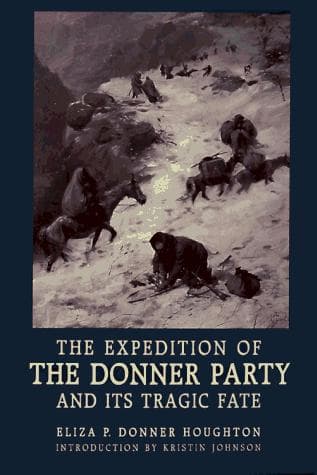
The Expedition of the Donner Party and its Tragic FateHoughton, Eliza Poor Donner
History
The Expedition of the Donner Party and its Tragic Fate
Houghton, Eliza Poor Donner
Donner Party; Overland journeys to the Pacific
I remember well that new day. All plans for log cabins had to be
abandoned. There was no sheltered nook for shivering children, so
father lifted Georgia and me on to a log, and mother tucked a buffalo
robe around us, saying, "Sit here until we have a better place for
you." There we sat snug and dry, chatting and twisting our heads about,
watching the hurrying, anxious workers. Those not busy at the wagons
were helping the builders to construct a permanent camp.
They cleared a space under a tall pine tree and reset the tent a few
feet south of its trunk, facing the sunrise. Then, following the
Indian method as described by John Baptiste, a rude semi-circular hut
of poles was added to the tent, the tree-trunk forming part of its
north wall, and its needled boughs, the rafters and cross-pieces to the
roof. The structure was overlaid so far as possible with pieces of
cloth, old quilts, and buffalo robes, then with boughs and branches of
pine and tamarack. A hollow was scooped in the ground near the tree for
a fireplace, and an opening in the top served as chimney and
ventilator. One opening led into the tent and another served as an
outer door.
To keep the beds off the wet earth, two rows of short posts were driven
along the sides in the tent, and poles were laid across the tops, thus
forming racks to support the pine boughs upon which the beds should be
made. While this was being done, Elitha, Leanna, and Mrs. Wolfinger
were bringing poles and brush with which to strengthen and sheath the
tent walls against wind and weather. Even Sister Frances looked tall
and helpful as she trudged by with her little loads.
The combination of tent and hut was designed for my father and family
and Mrs. Wolfinger. The teamsters, Samuel Shoemaker, Joseph Rhinehart,
James Smith, and John Baptiste, built their hut in Indian wigwam
fashion. Not far from us, across the stream, braced against a log, was
reared a mixed structure of brush and tent for use of Uncle Jacob, Aunt
Betsy, and William and Solomon Hook (Aunt Betsy's sons by a former
husband), and their five small children, George, Mary, Isaac, Lewis,
and Samuel Donner.
Before we two could leave our perch, the snow was falling faster and in
larger flakes. It made pictures for Georgia and me upon the branches of
big and little trees; it gathered in a ridge beside us upon the log; it
nestled in piles upon our buffalo robe; and by the time our quarters
were finished, it was veiling Uncle Jacob's from view. Everything
within was cold, damp, and dreary, until our tired mother and elder
sisters built the fire, prepared our supper, and sent us to bed, each
with a lump of loaf sugar as comforter.
[Footnote 3: Thornton.]
CHAPTER VII
SNOWBOUND--SCARCITY OF FOOD AT BOTH CAMPS--WATCHING FOR RETURN OF
M'CUTCHEN AND REED.
Public-domain text, read in full here on John Shaqi.
Reviews
Reviews
No reviews yet
Be the first to share your thoughts on this work.
Join the Discussion
Join the discussion
Sign in to leave a comment or review.
Sign InorCreate an account