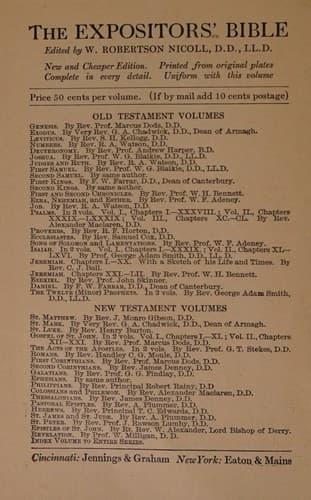
The Expositor's Bible: The Book of RevelationMilligan, William
Philosophy
The Expositor's Bible: The Book of Revelation
Milligan, William
Bible. Revelation -- Commentaries
And the sixth angel sounded, and I heard a voice from the horns of
the golden altar which is before God, one saying to the sixth
angel which had the trumpet, Loose the four angels which are bound
at the great river Euphrates. And the four angels were loosed,
which had been prepared for the hour, and day, and month, and
year, that they should kill the third part of men. And the number
of the armies of the horsemen was twice ten thousand times ten
thousand; I heard the number of them. And thus I saw the horses in
the vision, and them that sat on them, having breastplates as of
fire, and of hyacinth, and of brimstone. By these three plagues
was the third part of men killed, by the fire, and the smoke, and
the brimstone, which proceeded out of their mouths. For the power
of the horses is in their mouth, and in their tails: for their
tails are like unto serpents, and with them they do hurt. And the
rest of mankind which were not killed with these plagues repented
not of the works of their hands, that they should not worship
demons, and the idols of gold, and of silver, and of brass, and of
stone, and of wood: which can neither see, nor hear nor walk: and
they repented not of their murders, nor of their sorceries, nor of
their fornication, nor of their thefts (ix. 13-21).
There is much in this Trumpet that is remarkable even while we confine
ourselves to the more outward particulars contained in it. Thus we are
brought back by it to the thought of those prayers of the saints to
which all the Trumpets are a reply, but which have not been mentioned
since the blowing of the Trumpets began.[219] Once more we read of
_the golden altar which was before God_, in His immediate presence. On
that altar the prayers of all the saints had been laid, that they
might rise to heaven with the much incense added by the angel, and
might be answered in God's own time and way. The voice heard from _the
four horns_ of this altar--that is, from the four projecting points at
its four corners, representing the altar in its greatest
potency--shows us, what we might have been in danger of forgetting,
that the judgment before us continues to be an answer of the Almighty
to His people's prayers. Again it may be noticed that in the judgment
here spoken of we deal once more with a _third part_ of the class upon
which it falls. Nothing of the kind had been said under the fifth
Trumpet. The inference to be drawn from these particulars is
important. We learn that, however distinct the successive members of
any of the three series of the Seals, the Trumpets, or the Bowls may
seem to be, they are yet closely connected with one another. Though
seven in number, there is a sense in which they are also one; and any
characteristic thought which appears in a single member of the series
ought to be carried through all its members.[220]
Public-domain text, read in full here on John Shaqi.
Reviews
Reviews
No reviews yet
Be the first to share your thoughts on this work.
Elsewhere in the archive
Join the Discussion
Join the discussion
Sign in to leave a comment or review.
Sign InorCreate an account