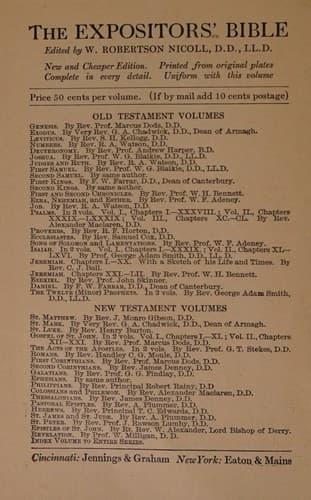
The Expositor's Bible: The Book of RevelationMilligan, William
Philosophy
The Expositor's Bible: The Book of Revelation
Milligan, William
Bible. Revelation -- Commentaries
The judgment itself is founded, as in the others already considered,
upon thoughts and incidents connected with Old Testament history.
The first of these is the river Euphrates. That great river was the
boundary of Palestine upon the northeast. "In the same day the Lord made
a covenant with Abram, saying, Unto thy seed have I given this land,
from the river of Egypt unto the great river, the river Euphrates;"[221]
and in the days of Solomon this part of the covenant appears to have
been fulfilled, for we are told that "Solomon reigned over all kingdoms
from the river" (that is, the Euphrates) "unto the land of the
Philistines, and unto the border of Egypt."[222] The Euphrates, however,
was not only the boundary between Israel and the Assyrians. It was also
Israel's line of defence against its powerful and ambitious neighbour,
who had to cross its broad stream before he could seize any part of the
Promised Land. By a natural transition of thought, the Euphrates next
became a symbol of the Assyrians themselves, for its waters, when they
rose in flood, overflowed Israel's territory and swept all before them.
Then the prophets saw in the rush of the swollen river a figure of the
scourge of God upon those who would not acknowledge Him: "The Lord spake
also unto me again, saying, Forasmuch as this people refuseth the waters
of Shiloah that go softly, and rejoice in Rezin and Remaliah's son; now
therefore behold, the Lord bringeth up upon them the waters of the
river, strong and many, even the king of Assyria, and all his glory: and
he shall come up over all his channels, and go over all his banks: and
he shall pass through Judah; he shall overflow and go over, he shall
reach even to the neck; and the stretching out of his wings shall fill
the breadth of Thy land, O Immanuel."[223] When accordingly the
Euphrates is here spoken of, it is clear that with the river as such we
have nothing to do. It is simply a symbol of judgment; and _the four
angels which had been bound at it_, but were now _loosed_, are a
token--four being the number of the world--that the judgment referred
to, though it affects but a third part of men, reaches men over the
whole surface of the globe. When _the hour, and the day, and the month,
and the year_--that is, when the moment fixed in the counsels of the
Almighty--come, the chains by which destruction has been kept back shall
be broken, and the world shall be overwhelmed by the raging stream.
Public-domain text, read in full here on John Shaqi.
Reviews
Reviews
No reviews yet
Be the first to share your thoughts on this work.
Elsewhere in the archive
Join the Discussion
Join the discussion
Sign in to leave a comment or review.
Sign InorCreate an account