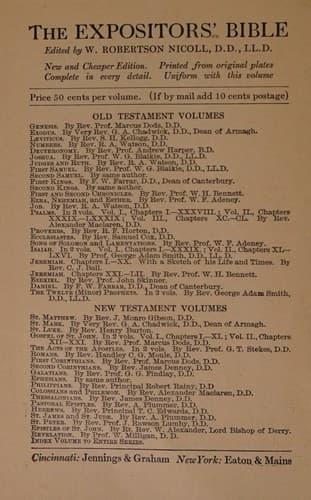
The Expositor's Bible: The Book of RevelationMilligan, William
Philosophy
The Expositor's Bible: The Book of Revelation
Milligan, William
Bible. Revelation -- Commentaries
1. Who is the angel introduced to us in the first verse of the vision?
He is described as _another strong angel_; and, as the epithet "strong"
has been so used only once before--in chap. v. 2, in connexion with the
opening of the book-roll sealed with seven seals--we are entitled to
conclude that this angel is said to be "another" in comparison with the
angel there spoken of rather than with the many angels that surround the
throne of God. But the "strong angel" in chap. v. is distinguished both
from God Himself, and from the Lamb. In some sense, therefore, a similar
distinction must be drawn here. On the other hand, the particulars
mentioned of this angel lead directly to the conclusion not only that he
has Divine attributes, but that he represents no other than that Son of
man beheld by St. John in the first vision of his book. He is _arrayed
with a cloud_; and in every passage of the Apocalypse where mention is
made of such investiture, or in which a cloud or clouds are associated
with a person, it is with the Saviour of the world as He comes to
judgment.[235] Similar language marks also the other books of the New
Testament.[236] _The rainbow was upon his head_; and the definite
article employed takes us back, not to the rainbow spoken of in the book
of Genesis, or to the rainbow which from time to time appears, a
well-known object, in the sky, but to that of chap. iv. 3, where we have
been told, in the description of the Divine throne, that "there was a
rainbow round about the throne, like an emerald to look upon." The words
_his face was as the sun_ do not of themselves prove that the reference
is to chap. i. 16, where it is said of the One like unto a son of man
that "His countenance was as the sun shineth in his strength;" but the
propriety of this reference is made almost indubitable by the mention of
_his feet as pillars of fire_, for this last circumstance can only be an
allusion to the trait spoken of in chap. i. 15, "And His feet like unto
fine brass, as if it had been refined in a furnace." The combination of
these particulars shows how close is the connexion between the "strong
angel" of this vision and the Divine Redeemer; and the explanation of
both the difference and the correspondence between the two is to be
found in the remark previously made that in the Apocalypse the "angel"
of any person or thing expresses that person or thing in action.[237]
Here, therefore, we have the action of Him who is the Head, and King,
and Lord of His Church.
Public-domain text, read in full here on John Shaqi.
Reviews
Reviews
No reviews yet
Be the first to share your thoughts on this work.
Elsewhere in the archive
Join the Discussion
Join the discussion
Sign in to leave a comment or review.
Sign InorCreate an account