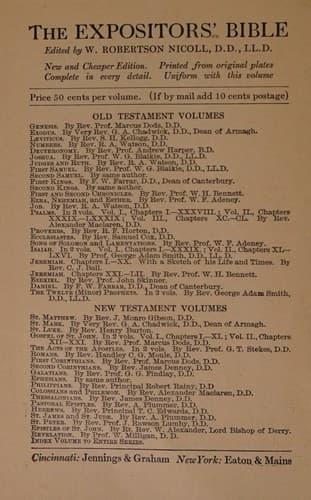
The Expositor's Bible: The Book of RevelationMilligan, William
Philosophy
The Expositor's Bible: The Book of Revelation
Milligan, William
Bible. Revelation -- Commentaries
should read, immediately after the words now under consideration, that
_Babylon the great was remembered in the sight of God, to give unto
her the cup of the wine of the fierceness of His wrath_. But the
answer is substantially contained in what has been said. When
Jerusalem is first thought of as "the great city," it is as the city
of "the Jews," as the centre and essence of those principles by which
spiritual is transformed into formal religion, and all sins are
permitted to hide and multiply under the cloak of a merely outward
piety. When it is next thought of as Babylon, the conception is
extended so as to embrace, not a false Judaism only, but a similar
falseness in the bosom of the universal Church. Just as "the great
city where also our Lord was crucified" widened in chap. xi. 8 to the
thought of Sodom and Egypt, so here it widens to the thought of
Babylon. May it not be added that we have thus in the mention of
Jerusalem and Babylon a counterpart to the mention in chap. xv. 3 of
"the song of Moses and the Lamb"? These two expressions, as we have
seen, comprehend a song of _universal_ victory. Thus also the two
expressions, "the great city" and "Babylon," having one and the same
idea at their root, comprehend all who in the professing Church of the
whole world are faithless to Christian truth.
Further effects of the last judgment follow. _Every island fled away,
and the mountains were not found._ Effects similar, though not so
terrible, had been connected with the sixth Seal. Mountains and
islands had then been simply "moved out of their places."[442] Now
they "flee away." Similar effects will again meet us, but in an
enhanced degree.[443] As yet, while mountains and islands flee away,
the earth and the heavens remain. In the last description of the
judgment of the wicked the heavens and the earth themselves flee away
from the face of Him that sitteth upon the throne, and no place is
found for them. The climax in the different accounts of what is
substantially the same event cannot be mistaken.
The same climax appears in the statement of the next effect, _the
great hail, every stone about the weight of a talent_, that is, fully
more than fifty pounds. No such weight had been spoken of at the close
of the seventh Trumpet in chap. xi. 19.
Again, however, there is no repentance and no conversion. Those who
suffer are the deliberate and determined followers of the beast. As
under the fourth Bowl, therefore, so under the seventh they rather
blaspheme God amidst their sufferings, _because of the plague of the
hail, for the plague thereof is exceeding great_.
FOOTNOTES:
[418] Exod. xv. 1.
[419] Isa. lxi. 10.
[420] Ezek. xxviii. 13.
[421] Comp. chap. vi.
[422] Exod. xl. 35.
[423] 1 Kings viii. 11.
[424] Isa. vi. 4.
[425] Exod. xix. 18; Heb. xii. 18.
[426] Chap. xv. 1.
[427] Comp. chap. viii. 7 and xvi. 2.
[428] Comp. chap. viii. 8, 9 and xvi. 3.
[429] Comp. chap. viii. 10, 11 and xvi. 4.
[430] Comp. chap. viii. 12 and xvi. 8.
Public-domain text, read in full here on John Shaqi.
Reviews
Reviews
No reviews yet
Be the first to share your thoughts on this work.
Elsewhere in the archive
Join the Discussion
Join the discussion
Sign in to leave a comment or review.
Sign InorCreate an account