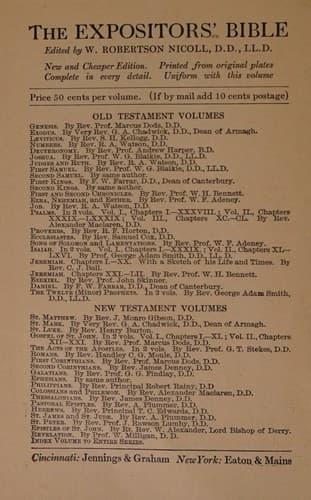
The Expositor's Bible: The Book of RevelationMilligan, William
Philosophy
The Expositor's Bible: The Book of Revelation
Milligan, William
Bible. Revelation -- Commentaries
[431] Exod. ix. 10.
[432] Exod. vii. 20.
[433] Exod. x. 21.
[434] Isa. xi. 15, 16.
[435] Isa. li. 10.
[436] Zech. x. 10-12.
[437] 1 Kings xxii. 19-22.
[438] Judges v.
[439] 2 Chron. xxxv. 22.
[440] Ephes. ii. 2.
[441] Chap. xi. 2; xx. 9.
[442] Chap. vi. 14.
[443] Chap. xx. 11.
CHAPTER XIII.
_THE BEAST AND BABYLON._
REV. xvii.
At the close of chap. xvi. we reached the end of the three great
series of judgments which constitute the chief contents of the
Revelation of St. John,--the series of the Seals, the Trumpets, and
the Bowls. It cannot surprise us, however, that at this point other
visions of judgment are to follow. Already we had reached the end at
chap. vi. 17, and again at chap. xi. 18; yet on both occasions the
same general subject was immediately afterwards renewed, and the same
truths were again presented to us, though in a different aspect and
with heightened colouring. We are prepared therefore to meet something
of the same kind now. Yet it is not the whole history of that "little
season" with which the Apocalypse deals that is brought under our
notice in fresh and striking vision. One great topic, the greatest
that has hitherto been spoken of, is selected for fuller
treatment,--the fall of Babylon. Twice before we have heard of Babylon
and of her doom,--at chap. xiv. 8, when the second angel of the first
group gathered around the Lord as He came to judgment exclaimed,
"Fallen, fallen, is Babylon the great, which hath made all the nations
to drink of the wine of the wrath of her fornication;" and again at
chap. xvi. 19, when under the seventh Bowl we were told that "Babylon
the great was remembered in the sight of God, to give unto her the cup
of the wine of the fierceness of His wrath." So much importance,
however, is attached by the Seer to the fortunes of this city that two
chapters of his book--the seventeenth and the eighteenth--are devoted
to the more detailed descriptions of her and of her fate. These two
chapters form one of the most striking, if at the same time one of the
most difficult, portions of his book. We have first to listen to the
language of St. John; and, long as the passage is, it will be
necessary to take the whole of chap. xvii. at once:--
Public-domain text, read in full here on John Shaqi.
Reviews
Reviews
No reviews yet
Be the first to share your thoughts on this work.
Elsewhere in the archive
Join the Discussion
Join the discussion
Sign in to leave a comment or review.
Sign InorCreate an account