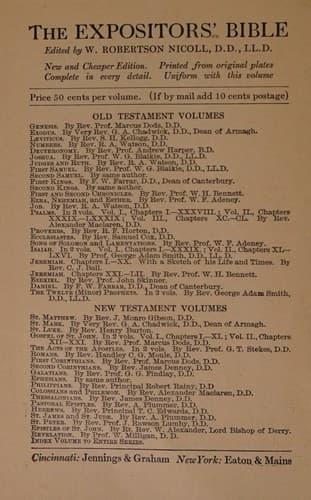
The Expositor's Bible: The Book of RevelationMilligan, William
Philosophy
The Expositor's Bible: The Book of Revelation
Milligan, William
Bible. Revelation -- Commentaries
A contrast presented in so many striking particulars leaves only one
conclusion possible. The two cities are the counterparts of one
another. But we know that by the first is represented the bride, the
Lamb's wife, or the true Church of Christ as, separated from the
world, she remains faithful to her Lord, is purified from sin, and is
made meet for that eternal home into which there enters nothing that
defiles. What can the other be but the representative of a false and
degenerate Church, of a Church that has yielded to the temptations of
the world, and has turned back in heart from the trials of the
wilderness to the flesh-pots of Egypt? Every feature of the
description answers, although with the heightened colour of ideal
portraiture, to what such a professing but degenerate Church
becomes,--the pride, the show, the love of luxury, the subordination
of the future to the present. Even her very cruelty to the poor saints
of God is drawn from actual reality, and has been depicted upon many a
page of history. With the meek and lowly followers of Jesus, whose
life is a constant protest that the things of time are nothing in
comparison with those of eternity, none have less sympathy than those
who have a name to live while they are dead. The world may admire,
even while it cannot understand, these little ones, these lambs of the
flock; but to those who seek the life that now is by the help of the
life that is to come they are a perpetual reproach, and they are felt
to be so. Therefore they are persecuted in such manner and to such
degree as the times will tolerate.
One other remark has to be made upon the identification of Jerusalem
and Babylon by the Seer. It has been said that he has one special
aspect of the metropolis of Israel in his eye. Yet we are not to
suppose that he confines himself to that metropolis. As on so many
other occasions, he starts from what is limited and local only to pass
in thought to what is unlimited and universal. His Jerusalem, his
Babylon, is not the literal city. She is "the great harlot that
sitteth upon many waters;" and "the waters which thou sawest," says
the angel to the Seer, "are peoples, and multitudes, and nations, and
tongues."[474] The fourfold division guides us, as usual, to the
thought of dominion over the whole earth. Babylon is not the Jerusalem
only of "the Jews." She is the great Church of God throughout the
world when that Church becomes faithless to her true Lord and King.
Public-domain text, read in full here on John Shaqi.
Reviews
Reviews
No reviews yet
Be the first to share your thoughts on this work.
Elsewhere in the archive
Join the Discussion
Join the discussion
Sign in to leave a comment or review.
Sign InorCreate an account