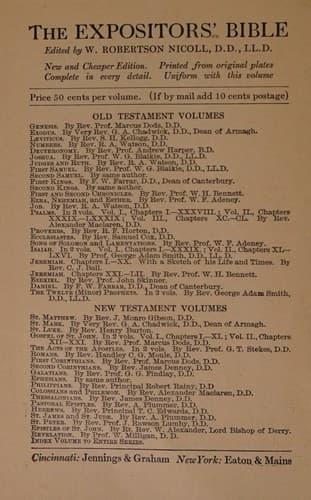
The Expositor's Bible: The Book of RevelationMilligan, William
Philosophy
The Expositor's Bible: The Book of Revelation
Milligan, William
Bible. Revelation -- Commentaries
Babylon then is not pagan Rome. No doubt seven mountains are spoken of
on which the woman sitteth. But this was not peculiar to Rome. Both
Babylon and Jerusalem are also said to have been situated upon seven
hills; and even if we had before us, as we certainly may have, a
distinct reference to Rome, it would be only because Rome was one of
the manifestations of the beast, and because the city afforded a
suitable point of departure for a wider survey. The very closing
words of the chapter, upon which so much stress is laid by those who
find the harlot in pagan Rome, negative, instead of justifying, the
supposition: _And the woman whom thou sawest is the great city, which
reigneth over the kings of the earth._ Rome never possessed such
universal dominion as is here referred to. She may illustrate, but she
cannot exhaust, that subtler, more penetrating, and more widespread
spirit which is in the Seer's view.
Again, Babylon cannot be papal Rome. As in the last case, there may
indeed be a most intimate connexion between her and one of the
manifestations of Babylon. But it is impossible to speak of the papal
Church as the guide, the counsellor, and the inspirer of
anti-christian efforts to dethrone the Redeemer, and to substitute the
world or the devil in His stead. The papal Church has toiled, and
suffered, and died for Christ. Babylon never did so.
Nor, finally, can we think of Babylon as a great city of the future
which shall stand to the kings and kingdoms of the earth in a relation
similar to that in which ancient Rome stood to the kings and kingdoms
of her day. Wholly apart from the impossibility of our forming any
clear conception of such a city, the want of the religious or
spiritual element is fatal to the theory.
One explanation alone seems to meet the conditions of the case.
Babylon is the world in the Church. In whatever section of the Church,
or in whatever age of her history, an unspiritual and earthly element
prevails, there is Babylon.
We have spoken of the two great figures of this chapter separately. We
have still to speak of their relation to one another, and of the
manner in which it is brought suddenly and for ever to a close.
Public-domain text, read in full here on John Shaqi.
Reviews
Reviews
No reviews yet
Be the first to share your thoughts on this work.
Elsewhere in the archive
Join the Discussion
Join the discussion
Sign in to leave a comment or review.
Sign InorCreate an account