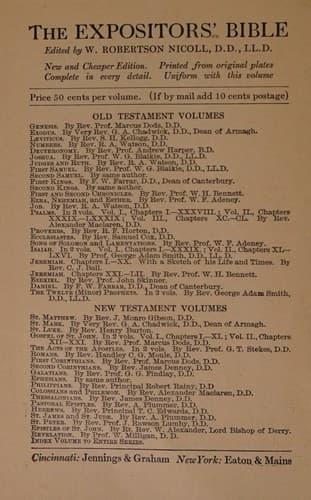
The Expositor's Bible: The Book of RevelationMilligan, William
Philosophy
The Expositor's Bible: The Book of Revelation
Milligan, William
Bible. Revelation -- Commentaries
other with those spiritual forces which reach the profoundest depths
of the human heart and give rise to the greatest movements of human
history. The woman is therefore superior to the beast. She inspires
and animates him. The beast only lends her the material strength
needed for the execution of her plans. In the war, accordingly, which
is carried on by the ten kings who have _one mind, and who give their
power and authority unto the beast_, in the war which the beast and
they, with their combined power, wage _for one hour_ against the Lamb,
it would be a great mistake to suppose that the woman, although she is
not mentioned, takes no part and exerts no influence. She is really
there, the prime mover in all its horrors. The "one mind" comes from
her. The beast can do nothing of himself. The ten kings who are the
form in which he appears are not less weak and helpless. They have the
outward power, but they cannot regulate it. They want the skill, the
subtlety, the wisdom, which are found only in the spiritual domain.
But the great harlot, who at this point of history is the perversion
of _Christian_ truth, is with them; and they depend on her. Such is
the first part of the relation between the beast and the harlot.
A second, most unexpected and most startling, follows.
We have seen that in the war between the ten kings and the Lamb the
woman is present. That war ends in disaster to her and to those whom
she inspires. _The Lamb shall overcome them: for He is Lord of lords,
and King of kings._ The name is the same as that which we shall
afterwards meet in chap. xix. 16, though the order of the clauses is
different. This Lamb, therefore, is here the Conqueror described in
chap. xix. 11-16; and many particulars of these latter verses take us
back to the Son of man as He appeared in chap. i., or, in other words,
to the risen and glorified Redeemer. The thought of the risen Christ
is thus in the mind of St. John when he speaks of the Lamb who shall
overcome. The leaders of the Jewish Church had believed that they had
for ever rid themselves of the Prophet who "tormenteth them that dwell
on the earth."[477] They had sealed the stone, and set a watch, and
returned to their homes for joy and merriment. But on the third
morning there was a great earthquake, and the stone was rolled away
from the door of the sepulchre; and the Crucified came forth, the
Conqueror of death and Hades. Then the Lamb overcame. Then He began
His victorious progress as King of kings and Lord of lords. Then the
power and the wisdom of the world were alike put to shame. Was not
this enough? No, for now follow the words which come upon us in a way
so wholly unexpected: _And the ten horns which thou sawest, and the
beast, these shall hate the harlot, and shall make her desolate and
naked, and shall eat her flesh, and shall burn her utterly with fire._
Public-domain text, read in full here on John Shaqi.
Reviews
Reviews
No reviews yet
Be the first to share your thoughts on this work.
Elsewhere in the archive
Join the Discussion
Join the discussion
Sign in to leave a comment or review.
Sign InorCreate an account