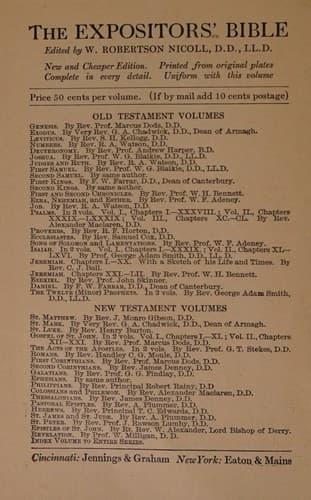
The Expositor's Bible: The Book of RevelationMilligan, William
Philosophy
The Expositor's Bible: The Book of Revelation
Milligan, William
Bible. Revelation -- Commentaries
The first words of this voice from heaven deserve peculiar attention:
_Come forth, My people, out of her_; that is, out of Babylon, the
degenerate Church. We are at once reminded of the striking teaching of
our Lord in chap. x. of the fourth Gospel, where He compares Himself
to the "door" of the fold, not the door by which the sheep enter into,
but by which they come out of, the fold.[483] We are also reminded of
the blind man of chap. ix. of the same Gospel, whom our Lord "found"
only after he had been "cast out" of the synagogue.[484] In the midst
of the blinded theocracy of Israel in the days of Jesus there was a
faithful, though small, remnant. It had been betrayed by the
religious guides of the people, who had become "thieves and robbers,"
whom the true sheep did not know, and to whom they ought not to
listen. Jesus came to call it out of the theocracy to Himself. Such
was the spectacle which St. John had witnessed when his Master was in
the world, and that experience is now repeated. The Church as a whole
degenerates. Called to prepare men for the Second Coming of the Lord,
and to teach them to live, not for the present, but the future, she
becomes herself the victim of the present. She forgets that, in the
absence of the Bridegroom, her days are days of fasting. She fails to
realize the fact that until her Lord comes again her state is one of
widowhood. And, instead of mourning, she sits as a queen, at ease and
satisfied, proud of her pomp and jewellery. What is all this but a
recurrence of the old events of history? The Apostle sees the future
mirrored in the past; and he can only follow in his Master's
footsteps, and call His Christian remnant out of Babylon.
The words are in the highest degree important for the interpretation
and understanding of the Apocalypse. We have already found in more
than one passage distinct traces of this double Church, of the true
Church within the false, of the few living ones within the Body which
had a name to live, but was dead. Here the distinction meets us in all
its sharpness, and fresh light is cast upon passages that may have
formerly seemed dark. "Many are called," "many" constituting the
outward Church; but "few are chosen," "few" constituting the real
Church, the Church which consists of the poor, and meek, and lowly.
The two parts may keep together for a time, but the union cannot
last; and the day comes when, as Christ called His sheep out of the
Jewish, so He will again call His sheep out of the Christian "fold,"
that they may hear His voice, and follow Him.
Public-domain text, read in full here on John Shaqi.
Reviews
Reviews
No reviews yet
Be the first to share your thoughts on this work.
Elsewhere in the archive
Join the Discussion
Join the discussion
Sign in to leave a comment or review.
Sign InorCreate an account