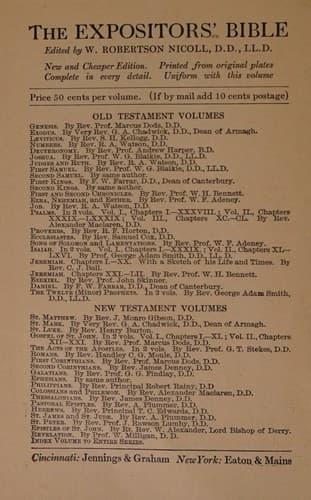
The Expositor's Bible: The Book of RevelationMilligan, William
Philosophy
The Expositor's Bible: The Book of Revelation
Milligan, William
Bible. Revelation -- Commentaries
Three classes of persons are introduced to us: Kings, Merchants, and
Sailors. All are _of the earth_; and each class, in its own strain,
swells the voice of lamentation. The words are largely taken from the
Old Testament, and more particularly from the description of the
overthrow of Tyre in Ezekiel (chaps. xxvi., xxvii.). There is even a
peculiar propriety in this latter reference, for Tyre was known by the
prophets as another Babylon. In describing the "Burden of Tyre,"
Isaiah uses in one part of his description the words, "The city of
confusion" (the meaning of the word Babylon) "is broken down."[487]
It is unnecessary to enter into any examination clause by clause of
the passage before us. We shall better catch its spirit and be made
sensible of its effect by attending to a few general observations upon
the description as a whole.
1. Not without interest may we mark that the classes selected to mourn
over the burning of the city are three in number. We have thus another
illustration of the manner in which that number penetrates the
structure of all the writings of St. John.
2. Emphasis is laid upon the fact that the city is _burned_. Her
destruction by fire has indeed been more than once alluded to. Of the
beast and the ten horns it had been said that "they shall burn her
utterly with fire;"[488] and, again, it had been proclaimed by the
voice from heaven that "she shall be utterly burned with fire."[489]
We shall not venture to say with any measure of positiveness that the
type of this "burning" is taken from the burning of Jerusalem by the
Romans. It may have been taken from the burning of other cities by
victorious enemies. But this much at least is obvious: that, in
conjunction with the fact that Babylon is a harlot, destruction by
fire leads us directly to the thought of the spiritual, and not simply
the civil, or political, or commercial, character of the city.
According to the law of Moses, burning appears to have been the
punishment of fornication only in the case of a priest's daughter:
"And the daughter of any priest, if she profane herself by playing the
harlot, she shall be burnt with fire."[490]
Public-domain text, read in full here on John Shaqi.
Reviews
Reviews
No reviews yet
Be the first to share your thoughts on this work.
Elsewhere in the archive
Join the Discussion
Join the discussion
Sign in to leave a comment or review.
Sign InorCreate an account