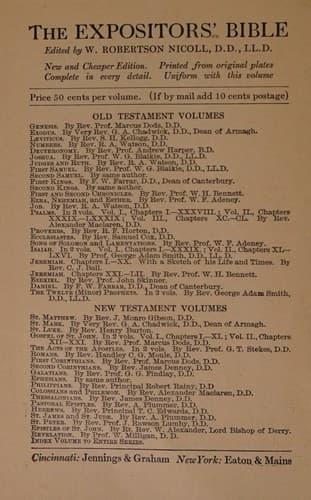
The Expositor's Bible: The Book of RevelationMilligan, William
Philosophy
The Expositor's Bible: The Book of Revelation
Milligan, William
Bible. Revelation -- Commentaries
part of the chapter.[518] In contrast with the joyful banquet at which
the children of God shall be nourished by Him whose flesh is meat
indeed and whose blood is drink indeed, the wicked, to whatever rank
or station they belong, shall themselves be a meal for all foul and
ravenous birds. The whole passage reminds us of the spectacle at
Calvary, as it is set before us in the fourth Gospel, and may be
accepted as one of the innumerable proofs of the similarity between
two books--that Gospel and the Apocalypse--at first sight so different
from each other. On the Cross Jesus is the true Paschal Lamb, not so
much in the moment of its death as at a subsequent stage, when it was
prepared for, and eaten at, the paschal meal. In the conduct of the
Jews on that occasion St. John appears to behold an inverted and
contorted Passover. The enemies of Jesus had not entered into the
judgment-hall of Pilate, "lest they should be defiled; but that they
might eat the passover."[519] They had not eaten it then Amidst the
tumult and stormy passions of that dreadful morning, when had they an
opportunity of eating it? St. John does not tell us that they found
one. Rather is the whole narrative so constructed, so full of close,
rapid, passionate action, that it is impossible to fix upon any point
at which we can insert their eating until it was too late to make it
legal. May it not be that they found no opportunity for eating it?
They lost their passover. Lost it? Nay; the Evangelist seems to say,
they found a passover. Go with me to the Cross; mark there their cruel
mockeries of the Lamb of God; and you shall see the righteous dealings
of the Almighty as He makes these mockeries take the shape of a
passover of judgment, a passover of added sin and deepened shame.[520]
The punishment of the wicked, and especially of the three great
enemies of the Church, now proceeds; and it ought still to be
carefully observed that we have to do with punishment, not war or
overthrow in war. It was so at ver. 17, where, after the triumphing
Conqueror had ridden forth, followed by His armies, there is no
mention of any battle. There is only the angel's cry to the birds to
gather themselves together unto the great supper of God. The battle
had been already fought, and the victory already won. We are now told
indeed of the gathering together of the beast and the kings of the
earth and their armies, _to make war against Him that sat upon the
horse, and against His army_. But, whatever may have been their
design, it is not executed. No actual fighting is spoken of. The
enemies referred to are at once taken, apparently without fighting,
and are consigned to the fate which they have brought upon themselves.
Public-domain text, read in full here on John Shaqi.
Reviews
Reviews
No reviews yet
Be the first to share your thoughts on this work.
Elsewhere in the archive
Join the Discussion
Join the discussion
Sign in to leave a comment or review.
Sign InorCreate an account