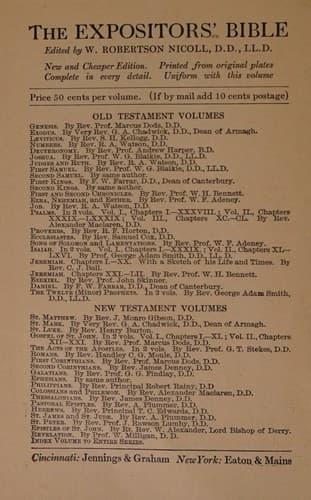
The Expositor's Bible: The Book of RevelationMilligan, William
Philosophy
The Expositor's Bible: The Book of Revelation
Milligan, William
Bible. Revelation -- Commentaries
Two of the three great enemies of the Lord and of His Church meet this
fate,--_the beast_ and _the false prophet_. The first of these is the
beast so frequently mentioned in previous chapters. More particularly
it is the beast of chap. xvii., the representative of the
antichristian world in its last and highest form. The second is not
less certainly the second beast of chap. xiii., of whom it is said
that "he deceiveth them that dwell on the earth by reason of the signs
which it was given him to do in the sight of the beast; saying to them
that dwell upon the earth, that they should make an image to the
beast."[521] The "signs," the "deception," and the "worship" of the
beast now spoken of can be no other than those thus referred to.
One point may be noticed further. According to what seems to be the best
reading of the original Greek, we are told here, not that "the beast was
taken, and with him the false prophet," but "the beast was taken, and he
that was with him, the false prophet." In other words, the language of
St. John is designed to bring out the closeness of connexion between
these two beasts, the fact that the one is always dependent on the
other. They are never separated. The first cannot act without the
second. Hence in all probability the reason why, in treating of the doom
by which these enemies of the Church are overtaken, a separate paragraph
is not assigned to each. They are taken together.
A more important question has been raised in connexion with the words
before us; and it has been urged that they conclusively prove that both
the beast and the false prophet are persons, not personifications.[522]
We have already seen that in regard to the "beast" that conclusion is
hasty.[523] It appears to be not less so in regard to the "false
prophet." The simple fact that he deceiveth _them_--that is, all _that
had received the mark of the beast_--is inconsistent with such an idea,
unless we ascribe to him a ubiquity that is Divine; or unless we
suppose, what Scripture gives us no warrant for believing, that there is
in the realm of evil a personal trinity--the dragon, the beast, and the
false prophet--corresponding to the Trinity of Father, Son, and Holy
Spirit. It is much more natural to think that St. John's statements upon
this point spring from that general method of conception which
distinguishes him, and by which everything existing in the realm of good
is thought of as having its counterpart in the realm of evil. The
question thus raised is wholly independent of any consideration of the
fate by which the two beasts are overtaken. When principles are viewed
as persons, they must be spoken of as persons; and it will surely not be
urged that death and Hades are persons because it is said of them, in
chap. xx. 14, that they "were cast into the lake of fire."
Public-domain text, read in full here on John Shaqi.
Reviews
Reviews
No reviews yet
Be the first to share your thoughts on this work.
Elsewhere in the archive
Join the Discussion
Join the discussion
Sign in to leave a comment or review.
Sign InorCreate an account