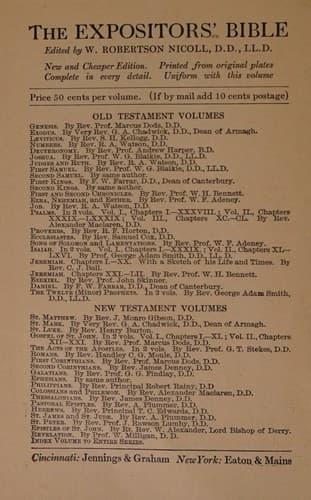
The Expositor's Bible: The Book of RevelationMilligan, William
Philosophy
The Expositor's Bible: The Book of Revelation
Milligan, William
Bible. Revelation -- Commentaries
Many may doubtless think that such a hope is too earthly, too
material, to be suited to the spiritual nature of the Christian
dispensation. They fear that it has a tendency to withdraw us from Him
who is "spirit," and who must be worshipped, if He is to be worshipped
acceptably, "in spirit and truth."[556] But any such apprehension is
at variance with the fundamental fact of our Christian faith, the
incarnation of our Lord, and is little less than the revival of the
old Manichean heresy that matter is essentially evil. Two errors have
existed, and may exist, in the Church upon this point. We may strip
the Gospel of its spiritual element, and may reduce it to a system of
outward and material forms, or we may strip it of its material
element, and may resolve it into a vague and shadowy mysticism. Both
are the errors of extremes, and it would be difficult to say which has
wrought most havoc in the Church. If the one was disastrous in the
days of the supremacy of Romanism, the other is hardly less disastrous
now. To the false and spurious spiritualism which it engenders we owe
not a few of the most serious misconceptions of the present time with
regard to the person of Christ, the Church, the Sacraments, and the
purpose of redemption as a whole.[557]
To return to the main question in connexion with the passage before
us. Does it present us with the picture of a general judgment or of a
judgment of the wicked alone? There is much in the passage that leads
distinctly to the latter conclusion.
1. The whole vision is obviously an enlargement of what we have
already met under the seventh Trumpet, when it was said that "the time
of the dead to be judged came."[558] In both visions the persons
spoken of as "the dead" must be the same; and they are clearly
distinguished in the earlier vision from those called "Thy servants
the prophets," the season of whose "reward" was come. With this
corresponds the fact that in the writings of St. John the words "to
judge" and "judgment" are always used, not in a neutral sense, but in
one tending to condemnation. Without some qualifying term the Apostle
could hardly have applied them to the acquittal of the righteous.
Public-domain text, read in full here on John Shaqi.
Reviews
Reviews
No reviews yet
Be the first to share your thoughts on this work.
Elsewhere in the archive
Join the Discussion
Join the discussion
Sign in to leave a comment or review.
Sign InorCreate an account