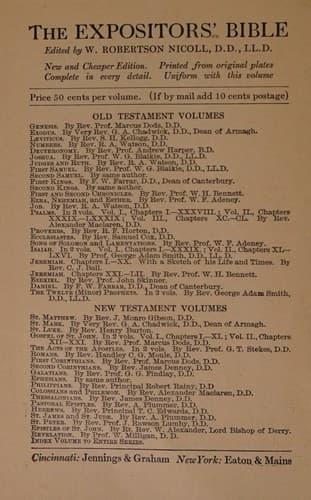
The Expositor's Bible: The Book of RevelationMilligan, William
Philosophy
The Expositor's Bible: The Book of Revelation
Milligan, William
Bible. Revelation -- Commentaries
2. The sources whence the "dead" are gathered confirm this conclusion.
These are three in number: _the sea_, _death_, and _Hades_. Looking
first at the two last of these, it is plain that "death" cannot in this
connexion be the neutral grave, for it is "cast into the lake of fire,"
where the devil, the beast, and the false prophet are. Similar remarks
apply to "Hades," which in chap. vi. 8 is the coadjutor of death, and
which in the New Testament always appears as a region of gloom, and
punishment, and opposition to the truth: "And thou, Capernaum, shalt
thou be exalted unto heaven? thou shalt go down unto Hades;" "And I also
say unto thee that thou art Peter, and upon this rock I will build My
Church; and the gates of Hades shall not prevail against it."[559] If
such be the sense in which we are to understand death and Hades, light
is thrown upon the manner in which we are to interpret the first of the
three sources,--"the sea." This cannot be the ocean, because the number
of those to be given up from its depths at the last day is comparatively
small; because, as the literal sea, it is in no way suitably associated
with death and Hades; and because, when we read in chap. xxi. 1, "And
the sea is no more," it is impossible to think that the word is used in
any other than a figurative sense. No reason can be imagined why, when
the earth is renewed, there should be no more that sea which is one
grand instrument of its present greatness and glory. Besides all this,
we have hitherto found that in the Apocalypse the "sea" is the emblem of
the unruly and troubled nations of the earth, and the source from which
the first beast of chap. xiii. had his origin. In the same sense
therefore we must understand it here. Like "death" and "Hades," "the
sea" spoken of can give up none but ungodly dead to the judgment of the
great day.
3. The "books" mentioned in the passage are clearly books containing
the record of evil deeds alone. When it is said that "books" were
opened, and that "another book was opened, which is the book of life,"
the "books" are distinguished from the "book." It harmonizes with this
that the book of life is not opened in order to secure deliverance for
those whose names are inscribed in it, but only to justify the
sentence passed on any who are cast into the lake of fire.
Public-domain text, read in full here on John Shaqi.
Reviews
Reviews
No reviews yet
Be the first to share your thoughts on this work.
Elsewhere in the archive
Join the Discussion
Join the discussion
Sign in to leave a comment or review.
Sign InorCreate an account