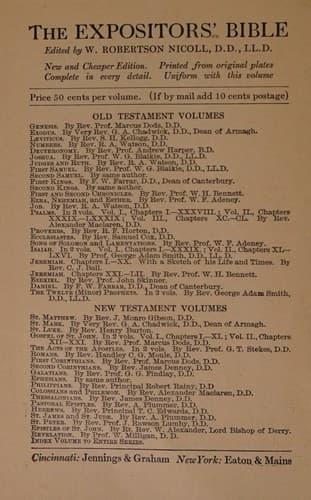
The Expositor's Bible: The Book of RevelationMilligan, William
Philosophy
The Expositor's Bible: The Book of Revelation
Milligan, William
Bible. Revelation -- Commentaries
(3) Let us look at chap. xxi. 27, where we read, "And there shall in
no wise enter into it anything unclean, or he that doeth an
abomination and a lie." These words distinctly intimate that the time
for final separation had not yet come. Persons of the wicked character
described must be supposed to be alive upon the earth after the new
Jerusalem has appeared.
5. Another consideration on the point under discussion may be noticed,
which will have weight with those who admit the existence of that
principle of structure in St. John's writings upon which it rests.
Alike in the Gospel and in the Apocalypse the Apostle is marked by a
tendency to return at the close of a section to what he had said at
the beginning, and to shut up, as it were, between the two statements
all he had to say. So here. In chap. i. 3 he introduces his Apocalypse
with the words, "For the time is at hand." In chap. xxii. 10,
immediately after closing it, he returns to the thought, "Seal not up
the words of the prophecy of this book: for the time is at hand;" that
is, the whole intervening revelation is enclosed between these two
statements. All of it precedes the "time" spoken of. The new Jerusalem
comes before the end.
In the new Jerusalem, therefore, we have essentially a picture, not of
the future, but of the present; of the ideal condition of Christ's true
people, of His "little flock" on earth, in every age. The picture may
not yet be realized in fulness; but every blessing lined in upon its
canvas is in principle the believer's now, and will be more and more his
in actual experience as he opens his eyes to see and his heart to
receive. We have been wrong in transferring the picture of the new
Jerusalem to the future alone. It belongs also to the past and to the
present. It is the heritage of the children of God at the very time when
they are struggling with the world; and the thought of it ought to
stimulate them to exertion and to console them under suffering.
FOOTNOTES:
[561] Trench, _Synonyms_, second series, p. 39.
[562] Comp. pp. 227, 357.
[563] Chap. iv. 3.
[564] Matt. v. 14.
[565] Ps. xxxi. 21; Isa. xxvi. 1.
[566] Ps. xci. 11.
[567] Comp. Ezek. xlviii. 31.
[568] Comp. Ezek. xl. 2, 3.
[569] Chap. xxi. 9.
[570] Ezek. xl. 1, 2.
[571] Ezek. xliii. 2.
[572] Ezek. xliv. 1-3.
[573] _The Apocalypse_, p. 438.
[574] Rom. i. 7; 1 Cor. i. 2; Col. i. 2.
[575] Col. i. 27; 1 Cor. i. 30; Phil. iii. 9.
[576] Eph. v. 25-27.
[577] Eph. i. 3.
[578] Phil. iii. 20.
[579] Heb. xii. 22, 23.
[580] John xiv. 20.
[581] John xvii. 22.
[582] 1 Pet. i. 8.
[583] Comp. Foxley, _Hulsean Lectures_, Lect. i.
[584] Commentary in _Clark's Foreign Theological Library_, _in loc._
CHAPTER XVIII.
_THE EPILOGUE._
REV. xxii. 6-21.
Public-domain text, read in full here on John Shaqi.
Reviews
Reviews
No reviews yet
Be the first to share your thoughts on this work.
Elsewhere in the archive
Join the Discussion
Join the discussion
Sign in to leave a comment or review.
Sign InorCreate an account