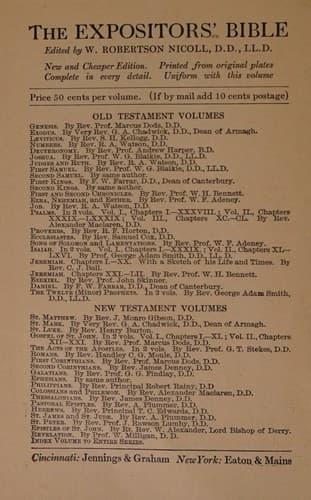
The Expositor's Bible: The Book of RevelationMilligan, William
Philosophy
The Expositor's Bible: The Book of Revelation
Milligan, William
Bible. Revelation -- Commentaries
The visions of the Seer have closed, and closed with a picture of the
final and complete triumph of the Church over all her enemies. No more
glorious representation of what her Lord has done for her could be set
before us than that contained in the description of the new Jerusalem.
Nothing further can be said when we know that in the garden of
Paradise Restored into which she is introduced, in the Holy of holies
of the Divine Tabernacle planted in the world, she shall eat of the
fruit of the tree of life, drink of the water of life, and reign for
ever and ever. Surely as these visions passed before the eye of St.
John in the lonely isle of Patmos he would be gladdened with the light
of heaven, and would need no more to strengthen him in the kingdom and
patience of Jesus Christ. Was it not too much? The Epilogue of the
book assures us that it was not; and that, although the natural eye of
man had not seen, nor his ear heard, nor his heart conceived the
things that had been spoken of, they had been revealed by the Spirit
of God Himself, not one word of whose promises would fail.
And he said unto me, These words are faithful and true: and the
Lord, the God of the spirits of the prophets, sent His angel to
show unto His servants the things which must shortly come to pass.
And, behold, I come quickly: blessed is he that keepeth the words
of the prophecy of this book.
And I John am he that heard and saw these things. And when I heard
and saw, I fell down to worship before the feet of the angel which
showed me these things. And he saith unto me, See thou do it not:
I am a fellow-servant with thee, and with thy brethren the
prophets, and with them which keep the words of this book: worship
God (xxii. 6-9).
Attention has been already called in this commentary both to that
characteristic of St. John's style as a writer which leads him, at a
longer or a shorter interval, to the point from which he started, and
to the fact that light is thus frequently thrown on the interpretation
of what he says.[585] Every illustration of such a point is therefore
not only interesting, but important; and in the words before us it is
illustrated with more than ordinary clearness.
The person introduced with the words _He said unto me_ is not indeed
named, but there can be little doubt that he is the angel spoken of in
the Prologue as sent to "signify" the revelation that was to
follow.[586]
Public-domain text, read in full here on John Shaqi.
Reviews
Reviews
No reviews yet
Be the first to share your thoughts on this work.
Elsewhere in the archive
Join the Discussion
Join the discussion
Sign in to leave a comment or review.
Sign InorCreate an account