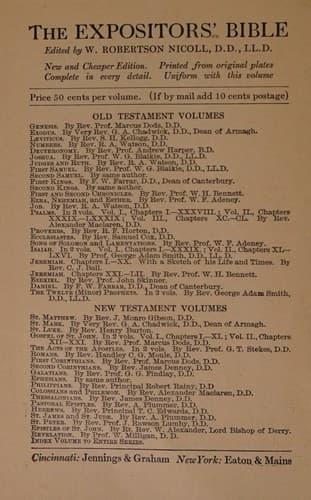
The Expositor's Bible: The Book of RevelationMilligan, William
Philosophy
The Expositor's Bible: The Book of Revelation
Milligan, William
Bible. Revelation -- Commentaries
(6) It is worthy of notice that the descriptions of our Lord given in
the first and last epistles have a wider application than to the
churches of Ephesus and Laodicea, to which they are immediately
addressed, thus making it evident that, while each of these epistles
has its own place in the series, it is at the same time treated as the
first or last member of a group which is to be regarded as a whole.
To the church of Ephesus the Saviour describes Himself as _He that
holdeth the seven stars in His right hand, He that walketh in the
midst of the seven golden candlesticks_[46]; and the description has
no more reference to Ephesus than to any other of the churches named.
In like manner to the church of Laodicea He describes Himself as _the
Amen, the Witness faithful and true, the Beginning of the creation of
God_.[47] The first of these appellations is no doubt derived from
Isa. lxv. 16, where we have twice repeated in the same verse the
formula "God Amen;" and the meaning of the name as applied to Jesus
is, not that all the Divine promises shall be accomplished by Him, but
that He is Himself the fulfilment of every promise made by the
Almighty to His people. The second appellation reminds us of John
xviii. 37, where Jesus replies to Pilate's question in the words, "To
this end have I been born, and to this end am I come into the world,
that I should bear witness unto the truth." His whole mission is
summed up by Him in the idea of "witnessing." He is the perfect, the
true, the real Witness to eternal truth in its deepest sense, in its
widest and most comprehensive range. The third appellation, again,
cannot be limited to the thought of the mere material creation, as if
equivalent to the statement that by the Word were all things made. It
would thus fail to correspond with the two appellations preceding it,
which undoubtedly apply to the work of redemption, while at the same
time the addition of the words "of God" would be meaningless or
perplexing. Let us add to this that in chap. i. 5, immediately after
Jesus has been called the "faithful Witness," He is described as the
"first-begotten of the dead," and we shall not be able to resist the
conviction that the words before us refer primarily to the new
creation, the Christian Church, that redeemed humanity which has its
true life in Christ. It may not indeed be necessary to exclude the
thought of the material universe; but, in so far as it is alluded to,
it is only as redeemed, in its ideal condition of rest and glory, when
the new Jerusalem has come down out of heaven, and when the Church's
enemies have been cast into the lake of fire.[48] The three
appellations, it will be observed, have thus a general rather than a
special aspect; and the salutation containing them is to be
distinguished from the salutations of the other epistles, all of
which, with the exception of the last, exhibit the closest possible
connexion with the contents of the epistles to which they respectively
belong.
Public-domain text, read in full here on John Shaqi.
Reviews
Reviews
No reviews yet
Be the first to share your thoughts on this work.
Join the Discussion
Join the discussion
Sign in to leave a comment or review.
Sign InorCreate an account