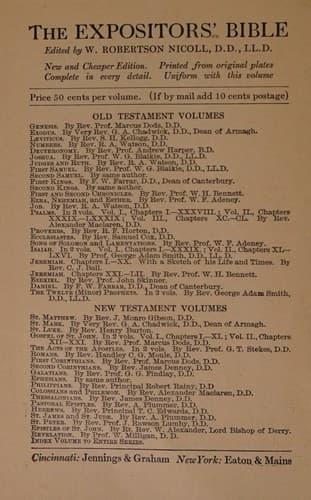
The Expositor's Bible: The Book of RevelationMilligan, William
Philosophy
The Expositor's Bible: The Book of Revelation
Milligan, William
Bible. Revelation -- Commentaries
The Salutation is addressed _to the seven churches which are in Asia_.
On this point it is enough to say that by the Asia spoken of we are to
understand neither the continent of that name, nor its great western
division Asia Minor, but only a single district of the latter, of
which Ephesus, where St. John spent the later years of his life and
ministry, was the capital. There the aged Apostle tended all those
portions of the flock of Christ that he could reach, and all the
churches of the neighbourhood were his peculiar care. We know that
these were in number more than seven. We know that to no church could
the Apostle be indifferent. The conclusion is irresistible, that here,
as so often in this book as well as in other parts of Scripture, the
number seven is not to be literally understood. Seven churches are
selected, the condition of which appeared most suitable to the purpose
which the Apostle has in view; and these seven represent the Church of
Christ in every country of the world, down to the very end of time.
The universal Church spreads itself out beneath his gaze; and before
he instructs he blesses it.
The blessing is, _Grace to you, and peace_; grace first, the Divine
grace, in its enlightening, quickening, and beautifying power; and
then peace, peace with God and man, peace that in the deep recesses of
the heart remains undisturbed by outward trouble, the peace of which
it is said by Him who is the Prince of peace, "Peace I leave with you;
My peace I give unto you: not as the world giveth give I unto you. Let
not your heart be troubled, neither let it be fearful."[4]
The source of the blessing is next indicated,--the Triune God, the
three Persons of the glorious Trinity, the Father, the Holy Spirit,
and the Son. Probably we should have thought of a different order; but
the truth is that it is the Son, as the manifestation of the Godhead,
who is mainly in the Apostle's mind. Hence the peculiarity of the
first designation, _Him which is, and which was, and which is to
come_, a designation specially applicable to our Lord. Hence also the
peculiarity of the second designation, _The seven Spirits which are
before His throne_; not so much the Spirit viewed in His individual
personality, in the eternal relations of the Divine existence, as that
Spirit in the manifoldness of His operation in the Church, the Spirit
of the glorified Redeemer,--not one therefore, but seven. Hence,
again, the peculiar designation of Christ, _Jesus Christ, who is the
faithful witness, the firstborn of the dead, and the ruler of the
kings of the earth_; not so much the Son in His metaphysical relation
to the Godhead, as in attributes connected with His redemptive work.
And hence, finally, the fact that when these three Persons have been
named, the Seer fills up the remaining verses of his Salutation with
thoughts, not of the Trinity, but of Him who has already redeemed us,
and who will in due time come to perfect our salvation.
Public-domain text, read in full here on John Shaqi.
Reviews
Reviews
No reviews yet
Be the first to share your thoughts on this work.
Join the Discussion
Join the discussion
Sign in to leave a comment or review.
Sign InorCreate an account