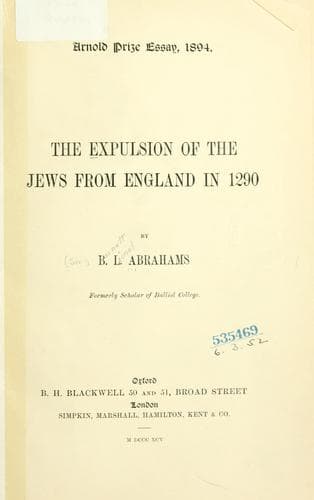
The expulsion of the Jews from England in 1290 — John Shaqi
The expulsion of the Jews from England in 1290Abrahams, Barnett Lionel
History
The expulsion of the Jews from England in 1290
Abrahams, Barnett Lionel
Jews -- Great Britain -- History
The 16,000[120] Jews of England were thus called upon to change at
once their old occupation for a new one, and the task was imposed upon
them under conditions which made it all but impossible of fulfilment.
They were forbidden to become burgesses of towns; and the effect of
the prohibition was to make it impossible for them, in most parts of
England, to become traders, for it practically excluded them from the
Gild Merchant. It is true that some towns professed that their Gild
was open to all the inhabitants, whether burgesses or not, so long
as they took the oath to preserve the liberties of the town and the
king’s peace.[121] But most of the Gilds were exclusive bodies, to
which all non-burgesses would find it hard to gain admission,[122] and
Jewish non-burgesses, though not as a rule kept out by a disqualifying
religious formula,[123] would on account of the unpopularity of their
race and religion, find it trebly hard.[124] As non-Gildsmen, they
would be at a disadvantage both in buying goods and in selling them.
They would find it hard to buy, because, in some towns at any rate, the
Gildsmen were accustomed to “oppress the people coming to the town with
vendible wares, so that no man could sell his wares to anyone except to
a member of the society.”[125] They would find it in all towns hard to
sell, in some impossible. In some towns non-Gildsmen were forbidden to
deal in certain articles of common use, such as wool, hides, grain,
untanned leather, and unfulled cloth; in others, as in Southampton,
they might not buy anything in the town to sell again there, or keep a
wine tavern, or sell cloth by retail except on market day and fair day,
or keep more than five quarters of corn in a granary to sell by retail.
There were even towns where the municipal statutes altogether forbade
non-Gildsmen to keep shops or to sell by retail.[126]
It was almost as difficult for Jews to become agriculturists or
artisans, as to become traders. They were allowed by the statute to
farm land, but for ten years only, and they were far too ignorant
of agriculture to be able to take advantage of the permission. They
could not work on the land of others as villeins, because, even if a
Christian lord had been willing to receive them, they would have been
prevented by their religion from taking the oath of fealty.[127]
Public-domain text, read in full here on John Shaqi.
Reviews
Reviews
No reviews yet
Be the first to share your thoughts on this work.
Join the Discussion
Join the discussion
Sign in to leave a comment or review.
Sign InorCreate an account