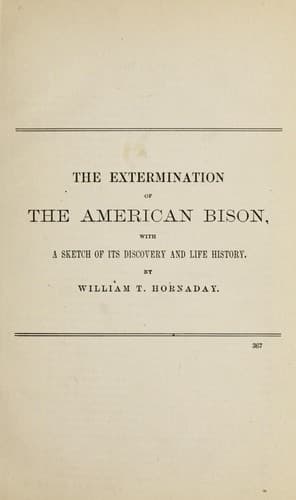
The Extermination of the American BisonHornaday, William T. (William Temple)
History
The Extermination of the American Bison
Hornaday, William T. (William Temple)
American bison; Wildlife conservation -- United States -- Sources
"After the start from the settlement has been well made, and all
stragglers or tardy hunters have arrived, a great council is held and a
president elected. A number of captains are nominated by the president
and people jointly. The captains then proceed to appoint their own
policemen, the number assigned to each not exceeding ten. Their duties
are to see that the laws of the hunt are strictly carried out. In 1840,
if a man ran a buffalo without permission before the general hunt began,
his saddle and bridle were cut to pieces for the first offense; for the
second offense his clothes were cut off his back. At the present day
these punishments are changed to a fine of 20 shillings for the first
offense. No gun is permitted to be fired when in the buffalo country
before the 'race' begins. A priest sometimes goes with the hunt, and
mass is then celebrated in the open prairies.
"At night the carts are placed in the form of a circle, with the horses
and cattle inside the ring, and it is the duty of the captains and their
policemen to see that this is rightly done. All laws are proclaimed in
camp, and relate to the hunt alone. All camping orders are given by
signal, a flag being carried by the guides, who are appointed by
election. Each guide has his tarn of one day, and no man can pass a
guide on duty without subjecting himself to a fine of 5 shillings. No
hunter can leave the camp to return home without permission, and no one
is permitted to stir until any animal or property of value supposed to
be lost is recovered. The policemen, at the order of their captains, can
seize any cart at night-fall and place it where they choose for the
public safety, but on the following morning they are compelled to bring
it back to the spot from which they moved it the previous evening. This
power is very necessary, in order that the horses may not be stampeded
by night attacks of the Sioux or other Indian tribes at war with the
half-breeds. A heavy fine is imposed in case of neglect in extinguishing
fires when the camp is broken up in the morning.
"In sight of buffalo all the hunters are drawn up in line, the
president, captains, and police being a few yards in advance,
restraining the impatient hunters. 'Not yet! Not yet!' is the subdued
whisper of the president. The approach to the herd is cautiously made.
'Now!' the president exclaims; and as the word leaves his lips the
charge is made, and in a few minutes the excited half-breeds are amongst
the bewildered buffalo."
"After witnessing one buffalo hunt," says Prof. John Macoun, "I can not
blame the half-breed and the Indian for leaving the farm and wildly
making for the plains when it is reported that buffalo have crossed the
border."
Public-domain text, read in full here on John Shaqi.
Reviews
Reviews
No reviews yet
Be the first to share your thoughts on this work.
Elsewhere in the archive
Join the Discussion
Join the discussion
Sign in to leave a comment or review.
Sign InorCreate an account