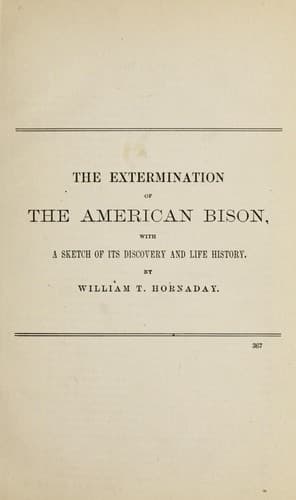
The Extermination of the American BisonHornaday, William T. (William Temple)
History
The Extermination of the American Bison
Hornaday, William T. (William Temple)
American bison; Wildlife conservation -- United States -- Sources
In the absence of facts based on personal observations, I may be
permitted to advance an opinion in regard to the wood buffalo. There is
some reason for the belief that certain changes of form may have taken
place in the buffaloes that have taken up a permanent residence in
rugged and precipitous mountain regions. Indeed, it is hardly possible
to understand how such a radical change in the habitat of an animal
could fail, through successive generations, to effect certain changes in
the animal itself. It seems to me that the changes which would take
place in a band of plains buffaloes transferred to a permanent mountain
habitat can be forecast with a marked degree of certainty. The changes
that take place under such conditions in cattle, swine, and goats are
well known, and similar causes would certainly produce similar results
in the buffalo.
The scantier feed of the mountains, and the great waste of vital energy
called for in procuring it, would hardly produce a larger buffalo than
the plains-fed animal, who acquires an abundance of daily food of the
best quality with but little effort.
We should expect to see the mountain buffalo smaller in body than the
plains animal, with better leg development, and particularly with
stronger hind quarters. The pelvis of the plains buffalo is surprisingly
small and weak for so large an animal. Beyond question, constant
mountain climbing is bound to develop a maximum of useful muscle and
bone and a minimum of useless fat. If the loss of mane sustained by the
African lions who live in bushy localities may be taken as an index, we
should expect the bison of the mountains, especially the "wood buffalo,"
to lose a great deal of his shaggy frontlet and mane on the bushes and
trees which surrounded him. Therefore, we would naturally expect to find
the hair on those parts shorter and in far less perfect condition than
on the bison of the treeless prairies. By reason of the more shaded
condition of his home, and the decided mitigation of the sun's
fierceness, we should also expect to see his entire pelage of a darker
tone. That he would acquire a degree of agility and strength unknown in
his relative of the plain is reasonably certain. In the course of many
centuries the change in his form might become well defined, constant,
and conspicuous; but at present there is apparently not the slightest
ground for considering that the "mountain buffalo" or "wood buffalo" is
entitled to rank even as a variety of _Bison americanus_.
Colonel Dodge has recorded some very interesting information in regard
to the "mountain, or wood buffalo," which deserves to be quoted
entire.[34]
[Note 34: Plains of the Great West, p. 144-147.]
Public-domain text, read in full here on John Shaqi.
Reviews
Reviews
No reviews yet
Be the first to share your thoughts on this work.
Join the Discussion
Join the discussion
Sign in to leave a comment or review.
Sign InorCreate an account