That our sociological beliefs must also be profoundly affected by the
conclusions we draw on this point, is obvious. If a nation is modified
_en masse_ by transmission of the effects produced on the natures of its
members by those modes of daily activity which its institutions and
circumstances involve; then we must infer that such institutions and
circumstances mould its members far more rapidly and comprehensively
than they can do if the sole cause of adaptation to them is the more
frequent survival of individuals who happen to have varied in favourable
ways.
I will add only that, considering the width and depth of the effects
which acceptance of one or other of these hypotheses must have on our
views of Life, Mind, Morals, and Politics, the question—Which of them is
true? demands, beyond all other questions whatever, the attention of
scientific men.
_Brighton, January, 1887._
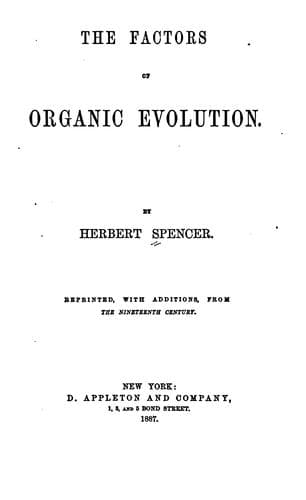
THE FACTORS OF ORGANIC EVOLUTION.
[_April and May, 1886_]
I.
Within the recollection of men now in middle life, opinion concerning
the derivation of animals and plants was in a chaotic state. Among the
unthinking there was tacit belief in creation by miracle, which formed
an essential part of the creed of Christendom; and among the thinking
there were two parties, each of which held an indefensible hypothesis.
Immensely the larger of these parties, including nearly all whose
scientific culture gave weight to their judgments, though not accepting
literally the theologically-orthodox doctrine, made a compromise between
that doctrine and the doctrines which geologists had established; while
opposed to them were some, mostly having no authority in science, who
held a doctrine which was heterodox both theologically and
scientifically. Professor Huxley, in his lecture on “The Coming of Age
of the Origin of Species,” remarks concerning the first of these parties
as follows:—
“One-and-twenty years ago, in spite of the work commenced by Hutton
and continued with rare skill and patience by Lyell, the dominant
view of the past history of the earth was catastrophic. Great and
sudden physical revolutions, wholesale creations and extinctions of
living beings, were the ordinary machinery of the geological epic
brought into fashion by the misapplied genius of Cuvier. It was
gravely maintained and taught that the end of every geological epoch
was signalised by a cataclysm, by which every living being on the
globe was swept away, to be replaced by a brand-new creation when
the world returned to quiescence. A scheme of nature which appeared
to be modelled on the likeness of a succession of rubbers of whist,
at the end of each of which the players upset the table and called
for a new pack, did not seem to shock anybody.
Public-domain text, read in full here on John Shaqi.
Reviews
Reviews
No reviews yet
Be the first to share your thoughts on this work.
Join the Discussion
Join the discussion
Sign in to leave a comment or review.
Sign InorCreate an account