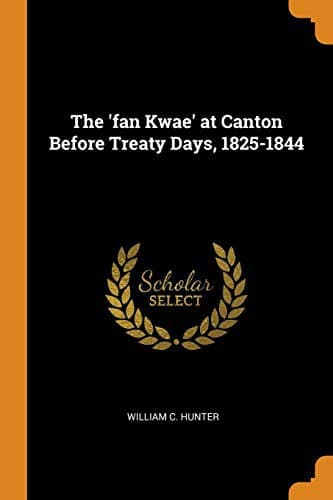
The 'Fan Kwae' at Canton Before Treaty Days 1825-1844Hunter, William C.
History
The 'Fan Kwae' at Canton Before Treaty Days 1825-1844
Hunter, William C.
Guangzhou (China) -- Commerce; Guangzhou (China) -- Description and travel
[11] An assistant-magistrate. Up to 1848 Macao was under the joint
government of the Portuguese and Chinese.
[12] At this time the ships' Compradores were engaged at Macao, and not
at Whampoa.
[13] Buddhist Temple.
[14] The Dutch East India Company.
[15] 'Man-ta-le'--Pigeon-English for 'Mandarin'
[16] A lac is 100,000.
[17] Pigeon-English for 'cold.'
[18] The best quality of birds' nests was brought from Java. This
'whimsical luxury' was worth 4,000 Spanish dollars per picul of 133-1/3
pounds.
[19] Pigeon-English for 'old friend.'
[20] Pigeon-English for 'quicksilver.'
[21] 'Unfortunate.'
[22] A complimentary term.
[23] Captain Elliot.
[24] Baring Brothers & Co.
[25] Pigeon-English for 'gentlemen.'
[26] A complimentary term.
[27] One of our partners whom we had sent to London. Lord Byron once
wrote of him to Murray as full of 'Entusymusy;' so we called him
'Tusymusy.'
[28] Their Chinese names were Tan and Tung, but these words not being
readily distinctive to the foreign ear, they both became Tom, while
'Old' and 'Young' were added to suit their respective ages.
[29] 'My compliments to you.'
[30] The chief of a foreign house was known as 'Tai-pan.' The word
signifies 'head manager.' The assistants or clerks were called
'pursers.' This word was undoubtedly taken from the office of 'purser,'
whom the Chinese had only known as transacting business for the
commanders of the East India Company's ships. The latter enjoyed the
privilege of forty tons of space (English measurement) in each vessel
homeward, which involved the presence at Canton of the 'pursers' to act
for them in selling their outward and buying their homeward investments.
The 'pursers' frequently hired a portion of a Factory (when to be had),
and resided in it more or less while their ships were at Whampoa.
[31] Since the Conquest the reverse bears the name of the Emperor in
Manchoo Tartar letters.
[32] Known as 'Sycee,' which means literally 'fine silk.'
[33] 10 cash = 1 candareen, 10 candareen = 1 mace, 10 mace = 1 tael.
[34] Bar gold, Sycee silver, chopped dollars.
[35] The Chinese called these boats 'scrambling dragons' and 'fast
crabs.'
[36] A chest contained 1 picul = 133-1/3 pounds.
[37] Often so called in official language.
[38] The 'Omega' belonged to Dent & Co.
[39] The 'Governor Findlay' to Jardine, Matheson, & Co.
[40] All opium vessels carried Shroffs.
[41] The Chinese character which represents 'day' is literally 'sun.'
[42] When a Chinese takes leave, he says, 'Kaou-tsze' ('I inform you of
taking leave').
[43] The 'Colonel Young' belonged to Jardine, Matheson, & Co., as well
as the 'Fairy.'
[44] The 'Harriet' belonged to Jardine, Matheson, & Co.
[45] Literally 'great wind,' not those destructive storms which occur
but once in three or four years, unroof houses and tear ships to pieces;
they are called Teĕt-kuy, 'iron whirlwinds.'
Public-domain text, read in full here on John Shaqi.
Reviews
Reviews
No reviews yet
Be the first to share your thoughts on this work.
Elsewhere in the archive
Join the Discussion
Join the discussion
Sign in to leave a comment or review.
Sign InorCreate an account