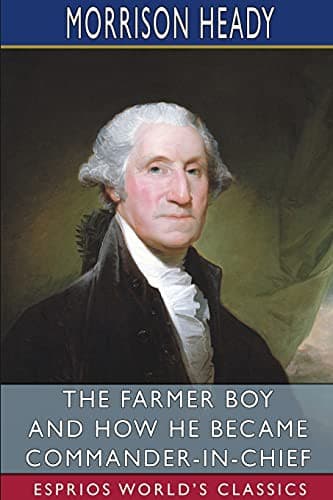
The Farmer Boy, and How He Became Commander-In-ChiefHeady, Morrison
History
The Farmer Boy, and How He Became Commander-In-Chief
Heady, Morrison
Washington, George, 1732-1799
This was a sore disappointment to Col. Washington; for he saw in it a
likelihood of Braddock's folly being played all over again, and that,
too, on a still larger scale. The tidings of glorious victories won by
British arms in the North had filled the whole country with triumph
and rejoicing, that rendered him all the more impatient at the
tardiness with which their own expedition was moving forward. "He
wished to rival the successes of the North by some brilliant blow in
the South. Perhaps a desire for personal distinction in the eyes of
the lady of his choice may have been at the bottom of his impatience."
This last, it is but fair to say, is an assertion of our great
countryman, Washington Irving; who, being a wise and learned
historian, would not have made it, you may be sure, had not his deep
insight into the workings of the human heart given him a perfect right
so to do. If this be not enough to convince you that such was really
the case, know that your Uncle Juvinell is entirely of the same
opinion.
XXI.
MORE BLUNDERING.
At last, about the middle of September, the expedition was set in
motion. Gen. Forbes sent Col. Boquet in advance, with nearly two
thousand men, to open and level the road. In order to get more certain
information touching the condition of the enemy,--his number,
strength, and probable designs,--it was thought advisable by some of
the officers to send out a large party of observation in the direction
of Fort Duquesne. It was to be made up of British regulars, Scotch
Highlanders, and Pennsylvania and Virginia rangers,--eight hundred
picked men in all. Washington strongly disapproved the plan, on the
ground that the regulars, being wholly unacquainted with the Indian
mode of fighting, and unable to operate at so great a distance without
taking with them a cumbrous train of baggage, would prove a
hinderance, instead of a furtherance, to an enterprise which must
needs owe its success to the caution, silence, secrecy, and swiftness
on the part of those engaged. He therefore advised the sending-out of
small companies of rangers and Indian hunters, who, knowing the
country well, could spy out the enemy with less risk of detection to
themselves, and, moving without baggage, could make far better speed
with the tidings they may have gathered. The like advice, you may
remember, he gave to Braddock. It met with a like reception, and the
like disaster was the consequence.
Public-domain text, read in full here on John Shaqi.
Reviews
Reviews
No reviews yet
Be the first to share your thoughts on this work.
Elsewhere in the archive
Join the Discussion
Join the discussion
Sign in to leave a comment or review.
Sign InorCreate an account