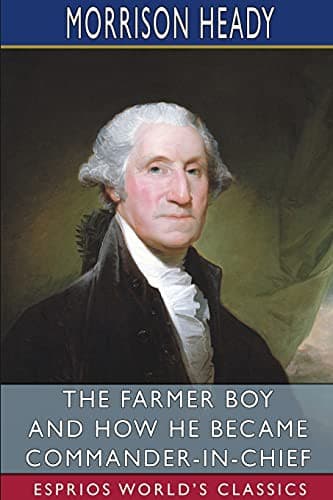
The Farmer Boy, and How He Became Commander-In-ChiefHeady, Morrison
History
The Farmer Boy, and How He Became Commander-In-Chief
Heady, Morrison
Washington, George, 1732-1799
It was not until the middle of November that the whole army came up to
Loyal Hannon, a little distance beyond Laurel Hill. Winter was coming
on apace. What with rain and snow and frost, the roads would soon be
rendered impassable, not only to wheeled carriages, but to pack-horses
also. Fifty miles of unbroken wilderness lay between them and Fort
Duquesne,--so long the goal of their hopes and toils, that seemed to
recede as they advanced, like some enchanted castle we have read of
before now in books of fairy tales, that poor benighted travellers
never reach, although, in fancy, every step they take brings them
nearer. The leaders began to talk seriously of going into
winter-quarters at that place until the return of spring; and it
seemed as if another of Washington's prophecies were likely to be
fulfilled. But, about this time, two prisoners from Fort Duquesne were
brought into camp; from whom they drew such an account of the weakness
of the French, and the discontent and daily desertions of their Indian
allies, as determined them to push forward without further delay, in
spite of the wintry weather, and, at one fell blow, make a finish of
the campaign. So, leaving behind them their tents and baggage, and
taking with them but a few pieces of light artillery, they once more
resumed their toilsome march. Col. Washington was ordered to go on in
advance with a part of his detachment, to throw out scouts and
scouting parties, who were to scour the woods in every direction, and
thereby prevent the possibility of an ambuscade. This new arrangement,
which showed that Gen. Forbes had the wisdom to profit by the folly of
those who had gone before him, was a signal proof of the high esteem
in which provincial troops were at last beginning to be held; and to
which, by their courage, skill, and hardihood, they had, even years
before, won so just a title.
When within a few miles of the French fort, the road began to show
signs of the late disaster. Here and there were to be seen the
blackened and mangled bodies of men, who, while fleeing for their
lives, had been overtaken, and cut down by the murderous tomahawk; or,
exhausted from the loss of blood, had there, by the lonely wayside,
laid them down to die of their wounds. As they advanced, these ghastly
tokens of defeat and massacre were to be met with at shorter and
shorter intervals, till at length they lay thickly scattered about the
ground.
Being now in close neighborhood with the enemy, the English moved with
even greater caution and wariness than before; for they had every
reason to suspect, that, as he had suffered them to come thus far
without molestation, he meant to meet them here, under shelter of his
stronghold, with a resistance all the move determined. When come in
sight, however, what was their surprise, instead of beholding the high
ramparts and strong walls, grim and frowning with cannon, which they
had pictured to their minds, to find a heap of blackened and smoking
ruins!
Public-domain text, read in full here on John Shaqi.
Reviews
Reviews
No reviews yet
Be the first to share your thoughts on this work.
Elsewhere in the archive
Join the Discussion
Join the discussion
Sign in to leave a comment or review.
Sign InorCreate an account