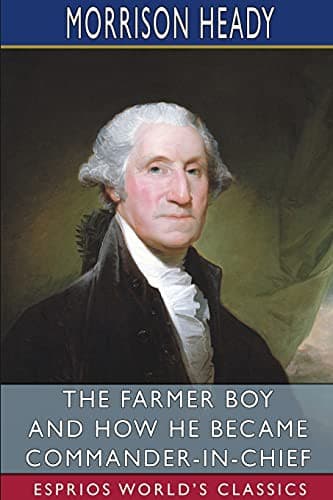
The Farmer Boy, and How He Became Commander-In-ChiefHeady, Morrison
History
The Farmer Boy, and How He Became Commander-In-Chief
Heady, Morrison
Washington, George, 1732-1799
Deserted by his Indian allies, threatened with famine, cut off from
all hope of aid from the North (where the English were everywhere
gaining ground), and with a force of but five hundred men wherewith to
defend the post against ten times that number, the French general had
seen that the attempt to hold it would be but folly; and, like a
prudent officer, had resolved to abandon it as his only chance of
safety. Waiting, therefore, until the English were within a day's
march of the place, he blew up the magazine, set fire to the works,
and, embarking in his bateaux by the light of the flames, retreated
down the Ohio.
Col. Washington, still leading the advance, was the first to enter;
and, with his own hand planting the British banner on the still
smouldering heaps, took formal possession thereof in the name of his
Britannic majesty, King George the Second. And thus this stronghold of
French power in the Ohio Valley, so long the pest and terror of the
border, fell without a blow. Under the name of Fort Pitt, it was soon
rebuilt, and garrisoned with two hundred of Washington's men; and,
from that time to the war of the Revolution, it was held by the
English, chiefly as a trading-post; and hence the dingy, smoky, noisy,
thriving, fast young city of Pittsburg.
They now had leisure to pay the last sad duty to the dead who had
fallen in the two defeats of Braddock and Grant. For three long years,
the bodies of Braddock's slaughtered men had lain without Christian
burial, bleaching in the sun of as many summers, and shrouded in the
snows of as many winters. Mingled with the bones of oxen and horses,
or half hidden in heaps of autumn leaves, they lay scattered about the
stony hillsides,--a spectacle ghastly indeed, and most melancholy to
behold. With many a sigh of pity for the hapless dead, and many a
shudder of dark remembrance on the part of those who had been present
at the scenes of rout and massacre, they gathered together the
blackened corpses of Grant's men and the whitened bones of Braddock's
men, and, digging a huge pit, buried them in one common grave. In this
pious duty all took part alike, from the general down to the common
soldier.
With the fall of Fort Duquesne, ended, as Washington had years ago
foreseen, the troubles of the Western and Southern frontiers, and with
it the power so long held by the French in the Ohio Valley. The
Indians, with that fickleness of mind peculiar to savage races, now
hastened to offer terms of amity and peace to the party whom the
fortunes of war had left uppermost.
Public-domain text, read in full here on John Shaqi.
Reviews
Reviews
No reviews yet
Be the first to share your thoughts on this work.
Elsewhere in the archive
Join the Discussion
Join the discussion
Sign in to leave a comment or review.
Sign InorCreate an account