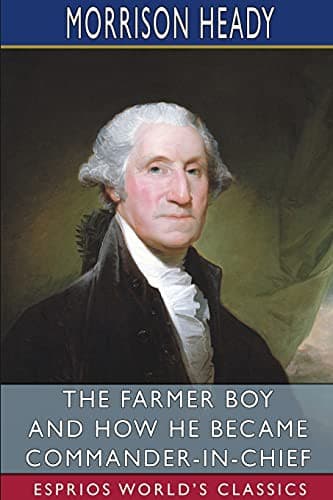
The Farmer Boy, and How He Became Commander-In-ChiefHeady, Morrison
History
The Farmer Boy, and How He Became Commander-In-Chief
Heady, Morrison
Washington, George, 1732-1799
From what you have just been told, you can have no difficulty in
guessing that Great Britain was desperately in debt, and in the very
mood to resort to desperate measures of delivering herself therefrom.
Her being in this particular mood at that particular time (for it is
only now and then that she has shown herself so unamiable) was owing
chiefly to the fact, that she was just then under the rule, or rather
misrule, of that narrow-minded, short-sighted, hard-fisted,
wrong-headed man, who commonly goes in history by the name of King
George the Third. Had he been the superintendent of a town workhouse,
he might perhaps have acquitted himself respectably enough; or, if I
may be so bold, he might have served a life-term as Governor of London
Tower, and gone to his grave without any great discredit or reproach:
but, in all human reason and justice, he certainly had no more
business on the throne of England than your Uncle Juvinell himself.
His ministers, who were of his own choosing, were vultures, of the
same harsh, unsightly plumage, and, at his beck or nod, stood ready to
do whatever knave's work he might have on hand,--even to the grinding
of his people's bones to make his bread, should his royal appetite
turn that way.
With such men at the helm of State, it is no wonder, then, that unwise
and oppressive measures should be resorted to for raising money, or,
as it is more properly called in such cases, a revenue, for paying the
debts and keeping up the expenses of the government. The first pounce
they made was on their young Colonies in America, whom they sought to
burden with heavy taxes laid on exports, or articles of commerce sent
out of the country, and on imports, or articles of commerce brought
into the country. The principal articles thus taxed were paper,
painters' colors, glass, sugar and molasses, and tea. The tax-money or
revenue scraped together from the sale of these articles--and which
made them dearer to him who bought and him who sold, according to the
amount of duty laid on--was to be gathered into the public treasury
for the purposes aforesaid. Another plan for raising revenue, hit upon
by these ingenious kites, was that famous one called the "Stamp Act,"
the design of which was to compel the people of the Colonies, in order
to make their business transactions good and valid, to use a certain
kind of paper, having on it a certain stamp. Each kind of paper had
its own particular stamp, and could only be applied to a certain
purpose specified thereon. Thus there was a deed stamp-paper, the will
stamp-paper, the note-of-hand and bill-of-exchange stamp-paper, the
marriage stamp-paper; and, in short, stamp-paper for every concern in
life requiring an instrument of writing. The paper itself was
altogether a commodity of the government, by whom it was manufactured,
and sold at prices varying from a few pence up to many pounds sterling
of good, hard English money, just according to the magnitude or nature
of the business in hand.
Public-domain text, read in full here on John Shaqi.
Reviews
Reviews
No reviews yet
Be the first to share your thoughts on this work.
Elsewhere in the archive
Join the Discussion
Join the discussion
Sign in to leave a comment or review.
Sign InorCreate an account