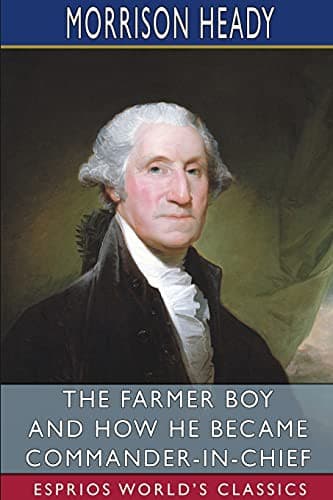
The Farmer Boy, and How He Became Commander-In-ChiefHeady, Morrison
History
The Farmer Boy, and How He Became Commander-In-Chief
Heady, Morrison
Washington, George, 1732-1799
A short time after the adjournment of Congress, at a second Virginia
Convention, held at Richmond, Patrick Henry, in closing one of the
grandest efforts he ever made, thus boldly declared his mind: "The
time of reconciliation is past; the time for action is at hand. It is
useless to send further petitions to the government, or to await the
result of those already addressed to the throne. We must fight, Mr.
Speaker: I repeat it, sir, we must fight! An appeal to arms and to the
God of hosts is all that is left us!" The great orator did but give
voice to the feelings and sentiments of thousands of pure patriots,
among whom was Washington, who represented his district in this
convention also. No one regretted more sincerely than he that they
were thus compelled to take up the sword as the only remedy of their
wrongs and grievances. In his own mind, he had fully resolved, if
needful, to devote his life and fortune to the cause; and was willing,
he told his brother, to arm and equip a thousand men at his own
expense, and lead them to the succor of Boston, at that time blockaded
by the British fleet. Grave and thoughtful, and pondering deeply all
these things, he went to his home; and, in this frame of mind, the
winter months passed slowly by.
It was now apparent to all, that open hostilities between the Colonies
and the mother-country were no longer avoidable; and on the nineteenth
of April, 1775, the battle of Lexington announced to the world that
the first blood of a desperate struggle had been shed, and that civil
war, with all its train of horrors, had begun.
When the tidings reached Mount Vernon, the impressions made on
Washington's mind were solemn and profound, if we may judge from a
letter written at the time, in which he says, "Unhappy it is to
reflect, that a brother's sword has been sheathed in a brother's
breast, and that the once-peaceful plains of America are to be
drenched with blood, or inhabited by slaves. Sad alternative! But can
a virtuous man hesitate in his choice?" Early in May, as he was just
on the eve of setting out for Philadelphia to take his seat in the
second session of the Congress, news reached him of the capture of
Ticonderoga by Col. Ethan Allen. It was a brilliant little exploit
enough, and the very kind to raise undue expectations in the many, who
looked no further into the future than to-night, when it is yet
evening; but it could have no other effect than to deepen the
thoughtfulness of a mind like Washington's, that could look through
the glare of these accidental hits of war, and behold the untried
perils still further beyond.
Public-domain text, read in full here on John Shaqi.
Reviews
Reviews
No reviews yet
Be the first to share your thoughts on this work.
Elsewhere in the archive
Join the Discussion
Join the discussion
Sign in to leave a comment or review.
Sign InorCreate an account