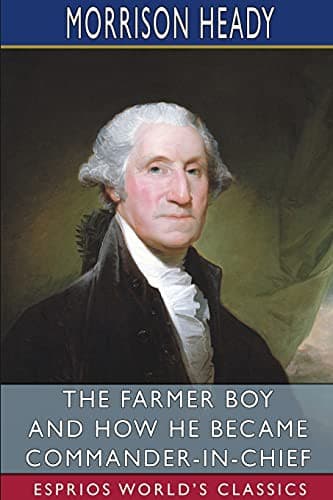
The Farmer Boy, and How He Became Commander-In-ChiefHeady, Morrison
History
The Farmer Boy, and How He Became Commander-In-Chief
Heady, Morrison
Washington, George, 1732-1799
It has often appeared strange to me that nothing should be known of
this great man's life up to the completion of his fifth year: and I am
sorry for your sakes, my little ones, that such is the case; for it
would be such a nice beginning to our story, could we say with
certainty that he distinguished himself by walking alone at the age of
five months; that he could pronounce "Mother" and "Good" with perfect
distinctness when but one year old; that his mother taught him at the
age of two to kneel by her side, and lisp, before going to his evening
rest, that beautiful prayer, beginning with, "Now I lay me down to
sleep;" that he rode like mad, at the age of three, round and round
the yard, on his father's buckhorn-headed cane; and that he rode on a
real horse at the age of four, and went galloping like a young Tartar
round and round the meadow in front of the house, to the delight of
his young mother, who watched him from the window. Of all this, and a
great deal more of the same sort, you would, I doubt not, like much to
hear, and I would like much to tell you; but we must keep within the
bounds of true history, and content ourselves with the knowledge of
that which really did happen. With this safe rule for our guidance, we
will therefore proceed at once to take up the thread of our story at
that period of George's boyhood, concerning which some certain record
has come down to our time.
At the age of five, when he was old enough to walk all alone for a
mile or two through the woods and fields, his parents started him to
school one bright spring morning, with his little basket on his arm,
containing his dinner and a bran-new spelling-book, to take his first
tiny steps in the flowery path of knowledge.
His first teacher was a Mr. Hobby, an old man, who lived on a distant
part of his father's plantation, and is said to have been besides the
sexton or grave-digger of the neighborhood; and was, I have my private
reasons for thinking, a broken-down old soldier, with a big cocked hat
that shaded a kindly and weather-beaten face, and a wooden leg,--an
ornament for which he was indebted to a cannon-ball, and took more
pride in than if it had been a sound one of flesh and bone. As it is
rarely ever the case that men with wooden legs are called upon to
fight the battles of their country, this worthy old man, who well knew
how to read and write, and cipher too, must needs earn his livelihood
by teaching school, and sowing his knowledge broadcast among the
little children of the neighborhood.
Public-domain text, read in full here on John Shaqi.
Reviews
Reviews
No reviews yet
Be the first to share your thoughts on this work.
Join the Discussion
Join the discussion
Sign in to leave a comment or review.
Sign InorCreate an account