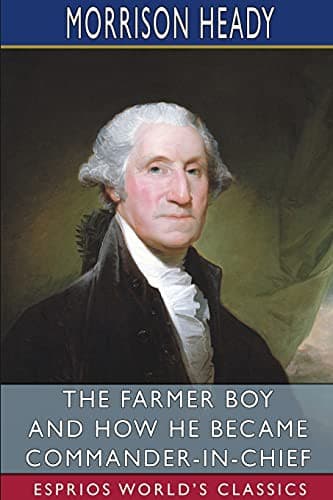
The Farmer Boy, and How He Became Commander-In-ChiefHeady, Morrison
History
The Farmer Boy, and How He Became Commander-In-Chief
Heady, Morrison
Washington, George, 1732-1799
It has been often remarked, that those men who have most distinguished
themselves in the world's history for noble thoughts and heroic deeds,
have, as a general thing, inherited those qualities of mind and heart
which made them great, from their mothers, rather than from their
fathers; and also that their efforts to improve and elevate the
condition of their fellow-beings have been owing in a larger measure
to the lessons of truth, piety, and industry, taught them by their
mothers in childhood and early youth. If this be the case, then how
much are we indebted for the freedom, prosperity, and happiness we
now enjoy above other nations of the earth, to Mary, the mother of
Washington! Perhaps, to give you a still more forcible idea of the
characters of both mother and son, and of the wholesome effects on him
of her judicious training, I ought to relate in this place the story
of his attempt at taming the sorrel horse.
A fine horse was an object that afforded Mrs. Washington, as it did
the other substantial Virginia ladies of that day, quite as much, if
not more, real pleasure than their more delicate grand-daughters of
the present now find in their handsome carriages, lap-dogs, and
canary-birds. So great was her fondness for this noble animal, that
she usually suffered two or three of her finest to run in a meadow in
front of the house, where she might look at them from time to time as
she sat sewing at her dining-room window. One of these was a young
sorrel horse, of great beauty of form, and fleetness of foot, but of
so wild and vicious a nature, that, for fear of accident, she had
forbidden any one to mount him, although he had already reached his
full height and size.
Now, you must know that a bolder and more skilful rider than George
was not to be found in all the Old Dominion, as Virginia is sometimes
called; and it was this early practice that afterwards won for him the
name of being the finest horseman of his day. Often, as we may very
naturally suppose to have been the case, would he reason thus with
himself, as, sitting on the topmost rail of a worm fence, he watched
the spirited young animal frisking and bounding about the field in all
the freedom of his untamed nature: "If I were but once upon his back,
with a strong bit in his mouth, believe me, I would soon make him a
thing of use as well as ornament; and it would, I am sure, be such a
pleasant surprise to mother to look from her window some fine morning,
and see me mounted on his back, and managing him with ease, and to
know that it was I who had subdued his proud spirit."
Public-domain text, read in full here on John Shaqi.
Reviews
Reviews
No reviews yet
Be the first to share your thoughts on this work.
Join the Discussion
Join the discussion
Sign in to leave a comment or review.
Sign InorCreate an account