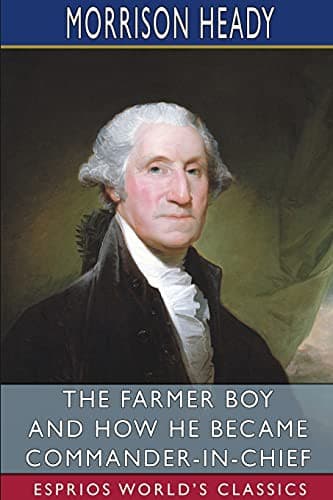
The Farmer Boy, and How He Became Commander-In-ChiefHeady, Morrison
History
The Farmer Boy, and How He Became Commander-In-Chief
Heady, Morrison
Washington, George, 1732-1799
Days, and even weeks, had now passed away, and still no enemy had come
to offer him battle. His men were becoming restless from inaction; and
the example of the troublesome Independents had already begun to stir
up discontent among them, which threatened, if not checked in season,
to end in downright insubordination. As the surest remedy for these
evils, Washington resolved to push forward with the road in the
direction of Fort Duquesne, and carry the war into the enemy's own
country. Requesting Capt. Mackay to guard the fort during his absence,
he set out with his entire force of three hundred men, and again began
the toilsome work of cutting a road through the wilderness. The
difficulties they had now to overcome were even greater than those
which beset them at the outset of their pioneering. The mountains
were higher, the swamps deeper, the rocks more massive, the trees
taller and more numerous, the torrents more rapid, the days more hot
and sultry, and the men and horses more enfeebled by poor and scanty
food. You will not wonder, then, that they were nearly two weeks in
reaching Mr. Gist's plantation on the Monongahela, a distance of but
fifteen miles.
But hardly had they pitched their tents, and thrown themselves on the
grass to snatch a little rest, when there came the disheartening
intelligence, brought in by their Indian spies, that Capt. de Villiers
had been seen to sally from Fort Duquesne but a few hours before, at
the head of a force of five hundred French and four hundred Indians,
and must by that time be within a few miles of the Virginia camp. For
three hundred weary and hungry men to wait and give battle to a force
three times their number, fresh and well fed, was a thing too absurd
to be thought of for a single moment. Washington, therefore, as their
only chance of safety, ordered a hasty retreat, hoping that they might
be able to reach the settlements on Wills's Creek before the enemy
could overtake him. The retreat, however, was any thing but a hasty
one; for the poor half-famished horses were at last no longer able to
drag the heavy cannon and carry the heavy baggage. Moved with pity for
the lean and tottering beasts, Washington dismounted from his fine
charger, and gave him for a pack-horse; which humane example was
promptly followed by his officers. Yet even this was not enough: so,
while some of the jaded men loaded their backs with the baggage, the
rest, as jaded, dragged the artillery along the stony roads with
ropes, rather than that it should be left behind to fall into the
hands of the enemy. For this good service, rendered so willingly in
that hour of sore distress, they went not unrewarded by their generous
young commander.
Public-domain text, read in full here on John Shaqi.
Reviews
Reviews
No reviews yet
Be the first to share your thoughts on this work.
Elsewhere in the archive
Join the Discussion
Join the discussion
Sign in to leave a comment or review.
Sign InorCreate an account