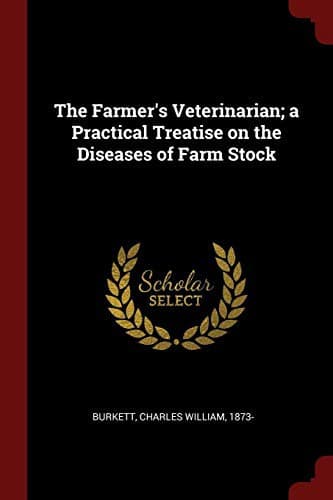
The Farmer's Veterinarian: A Practical Treatise on the Diseases of Farm StockBurkett, Charles William
Science
The Farmer's Veterinarian: A Practical Treatise on the Diseases of Farm Stock
Burkett, Charles William
Veterinary medicine
=HEAVES.=--The term “heaves” is used to describe that disease of the
horse which otherwise is known as “broken wind,” or technically as
“emphysema of the lungs.” This ailment, which is incurable when
thoroughly established and to which a tendency is inherited by the
offspring of an affected sire or dam, is characterized by the following
symptoms: Double, bellows-like action of the abdominal muscles in
breathing; short, suppressed cough, usually accompanied by passage of
gas from the rectum; gluttonous appetite; harsh, staring coat of hair;
pot belly; weakness; lack of endurance, sweating, panting, or staggering
during work; dilated nostrils; frequent passage of gas and soft,
foul-smelling feces when starting from stable.
The disease begins with indigestion, affecting in time the
pneumo-gastric nerve of the stomach and then the branch nerves running
to the lungs. At first the air tubules and vesicles of the lungs become
dilated (aneurism); later they may break down into large air spaces and
the surrounding lung tissues become involved (interlobular emphysema).
Air then is easily inhaled, but is exhaled with difficulty and the
effort causes cough and expulsion of gas (flatus).
The distress may be relieved by treatment, but perfect recovery is
impossible when the lungs have become badly affected. Treat by
substituting wet oat straw for hay in winter and grass for hay in
summer. Allow double the usual rest period after a meal. Work when
stomach is not distended with food. Do not feed hay at noon. Use lime
water to wet all food. Once or twice a week give raw linseed oil in a
bran mash to open bowels. Give half an ounce of Fowler’s solution of
arsenic night and morning. Do not breed from affected horses.
=HEAT EXHAUSTION AND SUNSTROKE.=--The horse that is stricken with heat
exhaustion or which falls from heat, apoplexy or “sunstroke,” is sick or
out of sorts at the time of attack; otherwise he would withstand heat
and work. The middle horse of a three-horse team suffers most and is apt
to succumb to the ill-effects of the combined radiation of heat from his
mates and direct rays of the sun. Attacks are most apt to happen on the
third or fourth day of a spell of intensely hot weather characterized by
mugginess, electrical storms and moisture-saturated air. At such times
the horse that has indigestion, a heavy, unhealthy coat of hair, a skin
or kidney trouble or any affection of the brain or heart is the one that
must be most carefully watched and worked.
With the hope of preventing attacks feed light rations, no corn, no
mashes, no ground feed other than bran; avoid green grass, unless the
horses are on it all of the time; do not feed hay at noon; allow cool,
pure drinking water often when horses are at work; keep stables clean,
darkened, screened, and ventilated; shade the polls of the horses’ heads
during work time and in such a way that air passes freely under the
shading device.
Public-domain text, read in full here on John Shaqi.
Reviews
Reviews
No reviews yet
Be the first to share your thoughts on this work.
Elsewhere in the archive
Join the Discussion
Join the discussion
Sign in to leave a comment or review.
Sign InorCreate an account