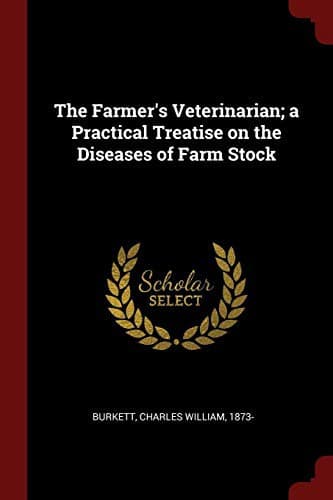
The Farmer's Veterinarian: A Practical Treatise on the Diseases of Farm StockBurkett, Charles William
Science
The Farmer's Veterinarian: A Practical Treatise on the Diseases of Farm Stock
Burkett, Charles William
Veterinary medicine
Until within recent years American authorities, bacteriologists and
veterinarians alike, have very generally accepted a certain germ, the
bacillus of Salmon and Smith, as the specific cause of hog cholera and
another somewhat similar germ as the cause of what was supposed to be a
distinct but curiously related disease--swine plague. But within a few
years workers in the Federal bureau of animal industry have apparently
demonstrated that hog cholera is caused by a living germ so small that
it passes easily through germ filters which remove all known forms of
the bacillus of Salmon and Smith.
It may be interesting to note further that this new germ is so small as
to be invisible to the highest available powers of the best microscope.
That it is a living organism and not a chemical poison may be very
easily demonstrated. The curious relations to this disease of the old
bacilli of hog cholera and of swine plague are not well understood, but
it seems quite possible that they may play some part in the later
development of the disease after the disease processes have been started
by the invisible germ. While our old theories and supposed information
concerning the cause of hog cholera have been very much disturbed by
newer work, it is important to remember that hog cholera is now just as
much as before to be recognized as a distinctly infectious disease. It
is important to remember also that this infection is absolutely
necessary, or there can be no cholera no matter how susceptible animals
may be. There can be no cholera without this primary and specific cause
any more than there can be plants in our wheat fields without the
previous presence of mustard seed. Conditions of soil and climate may
favor a rank growth of mustard. Conditions of feed and keep may favor
the development and spread of hog cholera. They may decrease resistance
and increase susceptibility, but cannot originally cause the disease. It
is a rather common experience that hogs kept closely housed and fed,
especially with such foods as corn, offer less resistance than do other
hogs. In our vaccine work we frequently find hogs of this type which die
readily under inoculation with blood of low grade virulence. Hogs of
hardier type may become slightly sick or not sick at all with
inoculation from the same infectious material. Pampered show herds
appear especially susceptible to both natural infection and artificial
inoculation.
Public-domain text, read in full here on John Shaqi.
Reviews
Reviews
No reviews yet
Be the first to share your thoughts on this work.
Elsewhere in the archive
Join the Discussion
Join the discussion
Sign in to leave a comment or review.
Sign InorCreate an account