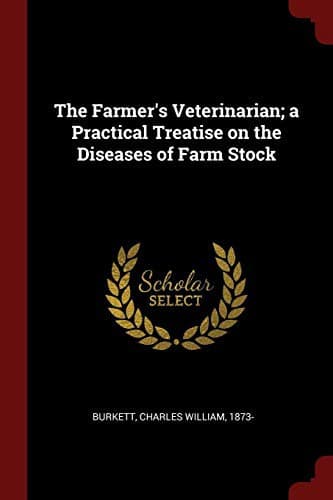
The Farmer's Veterinarian: A Practical Treatise on the Diseases of Farm StockBurkett, Charles William
Science
The Farmer's Veterinarian: A Practical Treatise on the Diseases of Farm Stock
Burkett, Charles William
Veterinary medicine
A peculiarity of glanders seems to be a tendency for the symptoms to
appear on the left side; in many cases of glanders the discharge and
ulceration is in the left nostril, and the left submaxillary gland is
enlarged; and in a large number of the cases of farcy met with it is the
left hind leg that shows the lesions of the disease. In obscure cases of
glanders or farcy the diagnosis is not always so easy, even for experts,
and then other methods for determining the trouble have to be resorted
to. These are the guinea pig test and the mallein test. The guinea pig
test consists of inoculating one or two of these little animals with the
discharge from a suspected horse’s nose, or from a farcy sore. If they
should develop glanders it would be proof positive that the suspected
horse had this disease; if they do not develop glanders it is not always
positive proof that the suspected horse is free from the disease.
Sometimes more than one test is necessary, or another method of
diagnosis may have to be resorted to. This is the mallein test.
Mallein is a product made from cultures of the glanders bacillus
analogous to tuberculin as made from cultures of the tubercle bacillus,
and is used for testing horses for glanders much as tuberculin is used
for testing cattle for tuberculosis. A horse infected with glanders will
react to a mallein test in much the same way as a cow infected with
tuberculosis will react to the tuberculin test. It is not customary in
some states to kill a horse that reacts to mallein unless it shows some
clinical evidence of disease. All horses that show clinical evidence of
glanders or farcy in some states are killed by the state authority, and
the law requires persons knowing or suspecting cases of this kind to
report in writing to the chief of the cattle bureau of the state board
of agriculture or to the inspector of animals in the city or town where
the disease is believed to exist, except in some cities where the city
board of health has full charge of glanders and farcy. Anyone selling,
removing, transporting, or concealing a horse knowing or having
reasonable cause to believe it has glanders or farcy is in most states
liable to a heavy penalty.
Public-domain text, read in full here on John Shaqi.
Reviews
Reviews
No reviews yet
Be the first to share your thoughts on this work.
Elsewhere in the archive
Join the Discussion
Join the discussion
Sign in to leave a comment or review.
Sign InorCreate an account