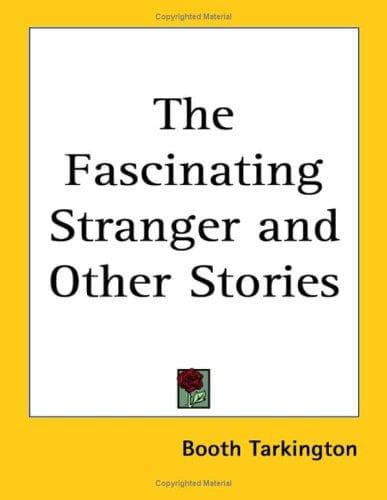
The Fascinating Stranger, and Other StoriesTarkington, Booth
General
The Fascinating Stranger, and Other Stories
Tarkington, Booth
Short stories, American; United States -- Social life and customs -- 20th century -- Fiction
In addition to all this, Muriel’s upness included “the new psychology”
and the appropriate humorous contempt for the Victorian Period, that
elastic conception of something-or-other which, according to the writing
young ladies and gentlemen who were her authorities, seemed to extend
from about the time of Custer’s Last Fight to the close of President
Wilson’s first administration. Muriel, like her original sources of
information, was just becoming conscious of herself as an authority at
about the latter date—she was sixteen then; and at twenty she began to
speak of having spent her youth in the Late Victorian Period. That
obscure decade before her birth, that time so formless and dark between
the years of our Lord 1890 and 1900, was Mid-Victorian; people still
mistook Tennyson and Longfellow for poets.
Sometimes older women thought Muriel a little hard; she was both
brilliant and scholarly, they admitted; but the papers she wrote for the
women’s clubs were so “purely intellectual,” so icily scientific, so
little reticent in the discussion of love, marriage and children, that
these ladies shook their heads. The new generation, as expressed by
Muriel, lacked something important, they complained; for nothing less
than maidenliness itself had been lost, and with it the rosebud
reveries, the twilight half-dreams of a coming cavalier, the embowered
guitar at moonrise. In a word, the charm of maidenhood was lost because
romance was lost. Muriel lacked the romantic imagination, they said, a
quality but ill replaced by so much “new thought.”
They made this mistake the more naturally because Muriel herself made
it, though of course she did not think of her supposed lack of romance
as a fault. She believed herself to be a severely practical person, and
an originally thinking person, as a quotation from one of her essays may
partly explain. “I face the actual world as it is; I face it without
superstition, and without tradition. Despising both the nonsense and the
misery into which former generations have been led by romance, I permit
no illusions to guide my thinking. I respect nothing merely because it
is established; I examine mathematically; I think mathematically; I
believe nothing that I do not prove. I am a realist.”
When she wrote this, she was serious and really thought it true; but as
a matter of fact, what she believed to be her thinking was the
occasional mulling over of scattered absorptions from her reading. Her
conception of her outward appearance, being somewhat aided by mirrors,
came appreciably near the truth, but her conception of her mind had no
such guide. Her mind spent the greater part of its time adrift in
half-definite dreaming, and although she did not even suspect such a
thing, her romantic imagination was the abode in which she really dwelt.
Public-domain text, read in full here on John Shaqi.
Reviews
Reviews
No reviews yet
Be the first to share your thoughts on this work.
Elsewhere in the archive
Join the Discussion
Join the discussion
Sign in to leave a comment or review.
Sign InorCreate an account