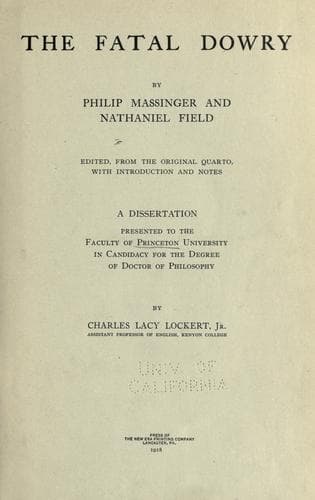
Dr. Ireland, in a postscript to the text of _The Fatal Dowry_ in
Gifford’s edition, agrees with Mason in assigning the Second Act
to Field and also the First Scene of the Fourth Act; the Third
Act, however, he claims for Massinger, as well as that share of
the play with which Mason credits him. Fleay and Boyle, the chief
modern commentators who have taken up the question of the division
of authorship with the aid of metrical tests and other criteria,
agree fairly well with the speculations of their less scientific
predecessors, and adopt an intermediate, reconciling position on the
disputed Third Act, dividing it between the two dramatists.[7]
Boyle (_Englische Studien_, V, 94) assigns to Massinger Act I; Act III
as far as line 316; Act IV, Scenes ii, iii, and iv; and the whole of
Act V, with the exception of Scene ii, lines 80-120, which he considers
an interpolation of Field, whom he also believes to have revised the
latter part of I, ii (from _Exeunt Officers with Romont_ to end).
Fleay (_Chron. Eng. Dra._, I, 208) exactly agrees with this division
save that the latter part of I, ii, which Boyle believes emended by
Field, he assigns to that author outright; and that he places the
division in Act III twenty-seven lines later (Field after _Manent Char.
Rom._).
In my own investigation I have used for each Scene the following tests
to distinguish the hands of the two authors:
(_a_) Broad aesthetic considerations: the comparison of style and
method of treatment with the known work of either dramatist.
(_b_) The test of parallel phrases. Massinger’s habit of repeating
himself is notorious. I have gone through the entire body of his
work, both that which appears under his name, and that which has been
assigned to him by modern research in the Beaumont & Fletcher plays,
and noted all expressions I found analogous to any which occur in
_The Fatal Dowry_. I have done the same for Field’s work, examining
his two comedies, _Woman is a Weathercock_ and _Amends for Ladies_,
and Acts I and V of _The Knight of Malta_ and III and IV of _The
Queen of Corinth_, which the consensus of critical opinion recognizes
(in my judgment, correctly) as his. He is generally believed to have
collaborated also in _The Honest Man’s Fortune_, but the exact extent
of his work therein is so uncertain that I have not deemed it a proper
field from which to adduce evidence. His hand has been asserted by one
authority or another to appear in various other plays of the period,
he having served, as it were, the role of a literary scapegoat on whom
it was convenient to father any Scene not identified as belonging to
Beaumont, Fletcher, or Massinger; but there is no convincing evidence
for his participation in the composition of any extant dramas save the
above named.
Public-domain text, read in full here on John Shaqi.
Reviews
Reviews
No reviews yet
Be the first to share your thoughts on this work.
Join the Discussion
Join the discussion
Sign in to leave a comment or review.
Sign InorCreate an account