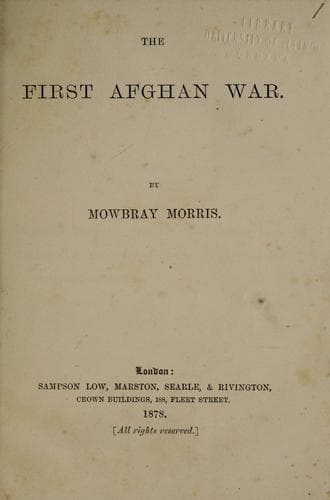
THE
FIRST AFGHAN WAR.
BY
MOWBRAY MORRIS.
London:
SAMPSON LOW, MARSTON, SEARLE, & RIVINGTON,
CROWN BUILDINGS, 188, FLEET STREET.
1878.
[_All rights reserved._]
PREFACE.
The following pages pretend to give nothing more than a short summary
of events already recorded by recognised authorities.
THE FIRST AFGHAN WAR.
It was in the year 1808, when the power of Napoleon was at its height,
that diplomatic relations were first opened between the Courts of
Calcutta and Cabul. Napoleon, when in Egypt, had meditated on the
chances of striking a fatal blow at England through her Indian
dependencies; some correspondence had actually passed between him and
Tippoo Saib on the subject, and subsequently, in 1801, he had concluded
a treaty with the Russian Emperor Paul for an invasion of India by
a force of 70,000 men, to be composed of equal parts of French and
Russian troops. The proposed line of march was to lie through Astrakhan
and Afghanistan to the Indus, and was to be heralded by Zemaun Shah,
who then ruled at Cabul, at the head of 100,000 Afghans. There was but
little danger indeed to be apprehended from Afghanistan alone, but
Afghanistan with Russia and France in the background was capable of
proving a very troublesome enemy. In such circumstances the attitude
of Persia was of the last importance, and Marquess Wellesley, then
Viceroy of India, at once proceeded to convert a possible enemy into
a certain and valuable ally. A young officer who had distinguished
himself under Harris at Seringapatam was selected for this delicate
service. How the young captain, whom Englishmen remember as Sir John
Malcolm, fulfilled his mission is matter of history. A thorough master
of all Oriental languages, and as skilful in council as he was brave in
the field, Malcolm soon pledged the Court of Persia to the interests
of England, and not only was it agreed that the two contracting
parties should unite to expel any French force that might seek to gain
a footing on any of the islands or shores of Persia, but the latter
Government bound itself to "slay and disgrace" any Frenchman found
in the country. This treaty, which may be thought to have somewhat
dangerously stretched the bounds of diplomatic hostility, was, however,
never formally ratified, and internal dissensions, culminating in the
deposition of Zemaun Shah by his brother Mahmoud, removed all danger
from our frontier for a time.
Public-domain text, read in full here on John Shaqi.
Reviews
Reviews
No reviews yet
Be the first to share your thoughts on this work.
Join the Discussion
Join the discussion
Sign in to leave a comment or review.
Sign InorCreate an account