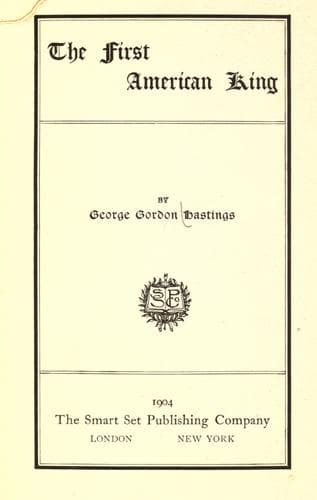
Science fiction; Speculative fiction; United States -- Politics and government -- Fiction
For a long minute they stood there, facing each other, undecided and
perplexed, bewildered by the strangeness of the situation. Kearns spoke
first.
“The end of our trouble lies there,” he exclaimed, pointing to the
village. “I’m hungry, thirsty and tired. Come!”
“I agree with you,” answered the Professor. “Let us push on, by all
means.”
In spite of heat and fatigue another half-hour found them on the
outskirts of the village. As they approached they were passed several
times by vehicles leaving the village and proceeding along the road at
a high rate of speed. The occupants of most of these vehicles scanned
the wayfarers with eager curiosity.
Reaching the village, the first thing to attract their attention was
the peculiar construction of its streets. The sidewalks on either side
of what appeared to be the principal street were moving sidewalks and
the roadway, where the vehicles passed up and down, was depressed to
a depth some twenty feet below the level of the sidewalks. At all the
street crossings were bridges connecting the sidewalks on either side
of the way.
“Well, I’m blessed!” exclaimed Kearns. “I had no idea there was such a
town as this in these parts, or anywhere else, for that matter!”
“It certainly seems to be a model place,” declared the Professor.
“Just look, what a splendid system of separating the vehicles from
pedestrians.”
“If such a system could be adopted in the city, it would annually save
many lives now lost in street accidents,” remarked Kearns.
The second house before them was a comfortable inn, with a low, wide
porch, holding a number of tables where sat men drinking.
“I am really very thirsty,” said the Professor. “Let us refresh
ourselves here before going further. Shall we take a table on the
porch?”
“No,” suggested Kearns, “let’s go inside. We’ll probably get quicker
service.”
They ascended the two steps, crossed the porch and entered what
appeared to be the bar-room. It was spacious, with tables and chairs on
either side of the entrance and with a long bar facing the door. Behind
the bar stood a white-jacketed bartender.
“What will you have?” inquired Kearns, as they reached the bar.
“A long drink of Rhine wine and seltzer,” answered the Professor.
Kearns turned to the bartender.
“A long drink of Rhine wine and seltzer and a high ball.”
“A long drink of Rhine wine and seltzer and a----?”
“High ball.”
“High ball? Never heard of it,” the bartender said thoughtfully.
“What!” exclaimed Kearns. “Never heard of a high ball? It’s the most
popular drink in the country.”
“That’s likely, isn’t it?” answered the bartender, with some scorn.
“I’ve worked in a good many places in New York and I never heard of
it.”
“Never heard of it!” cried Kearns. “Why, man, the head barkeeper of the
Waldorf-Astoria told me a couple of weeks--that is--ah--a couple of
months ago--that they sold over two hundred high balls a day.”
“The Waldorf-Astoria,” repeated the bartender, shortly; “what’s that?”
Public-domain text, read in full here on John Shaqi.
Reviews
Reviews
No reviews yet
Be the first to share your thoughts on this work.
Join the Discussion
Join the discussion
Sign in to leave a comment or review.
Sign InorCreate an account