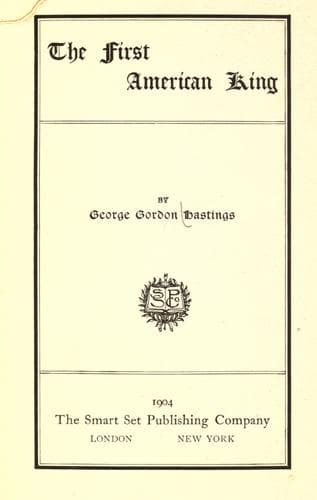
Science fiction; Speculative fiction; United States -- Politics and government -- Fiction
“You would doubtless prefer to hear how the great changes which have
taken place were brought about and learn of the events which led up
to them,” continued the Colonel. “For this we must go back to the
beginning of the century and the days when the various great Trusts
began to grow into maturity and strength. Just prior to the beginning
of the century had come the formation of the gigantic financial
organizations known as the Trusts. That is to say, they were regarded
as gigantic in that day, though as a matter of fact they had not yet
assumed the really colossal proportions they later attained. They were
then in their infancy, so to speak.”
“I can recall,” remarked Kearns, “a little billion-dollar concern.
Surely that was a pretty solid, bouncing infant!”
“A beggarly, puny infant?” retorted the Colonel, “as compared to
those born later. The Trusts grew until business upon anything but a
colossal scale was an impossibility and the smaller manufacturer and
the middleman were wiped out. In the course of time, by a brilliant
series of consolidations, seven great Trusts were formed which
practically absorbed the business of the country. The fields covered
by these Trusts were respectively: Alimentation, Transportation,
Manufacturing, Land, Ores and Minerals, Retailing, and finally, the
great Miscellaneous Trust which took in pretty well everything not
embraced by the others. These main Trusts subdivided their respective
fields between numerous subsidiary Trusts; but these subsidiary Trusts
all operated subject to the direction of the general head of that
particular Trust. The methods adopted by these organizations involved
the ruthless crushing out of all outside competition. For instance,
the Retailing Trust would start in by founding baker shops all over
a given city, and would sell bread at the actual cost of production.
With the enormous resources at the disposal of the Trust, this plan
of operations could be kept up indefinitely. What was the result? All
rivals were forced either to sell out to the Trust, or go to the wall.
Similar methods of procedure were adopted in other branches of retail
industry, one after the other, until the cream of the retail trade in
all the great cities was practically in the hands of the Trust. It was
a case of steady absorption. To oppose the Trust meant ruin and this
speedily came to be very thoroughly understood. Another example is the
Alimentation Trust, which deals with the foodstuffs, both solid and
liquid, of the country. With its enormous resources, it was enabled
to corner the raw material in one product after another until all
competition was forced out of existence.”
“And what did the People say to all this?” inquired Dean.
Public-domain text, read in full here on John Shaqi.
Reviews
Reviews
No reviews yet
Be the first to share your thoughts on this work.
Join the Discussion
Join the discussion
Sign in to leave a comment or review.
Sign InorCreate an account