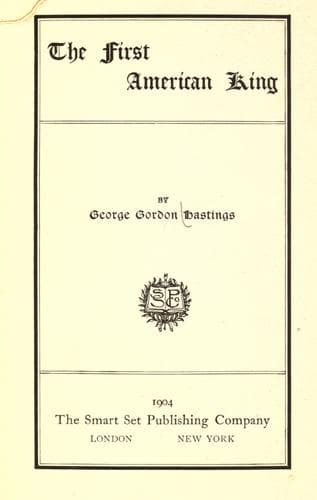
Science fiction; Speculative fiction; United States -- Politics and government -- Fiction
“A King at once! And why not?” continued the Colonel. “The country was
certainly ripe for it. The successful Trust controllers favored it
and behind them, as I have shown, were armies of people whose entire
interests were bound up in the Trusts and who, consequently, favored
whatever the Trusts desired. The officers of the Army and of the Navy
favored it. Class distinction had ever flourished in their ranks and a
monarchy would mean that crosses and decorations and all the brilliancy
and advantages of a court, as enjoyed by military and naval officers
in Europe, would be theirs. Society, of course, was in favor of it to
a unit and to the great majority of the women throughout the land the
proposition seemed to come as a not displeasing novelty. In a word,
while there was bitter opposition to the idea in many quarters, yet it
did not want for enthusiastic supporters in countless directions. As
for Marquanna, the great political chieftain, he boldly came out with
the declaration that the feature of a constantly changing President
had become intolerable and that the country’s urgent need was greater
stability and permanence in its executive head. He was not prepared
to say whether the mere election of the President for life would
sufficiently satisfy the country’s demands in this respect.”
“A bold leader! He had at least courage, if nothing else!” remarked
Dean.
“Owing to the condition of unrest in various parts of the country,”
continued the Colonel, “martial law was proclaimed and the regular
army was brought into active play. In the midst of the general turmoil
and confusion, Congress, under the leadership of Marquanna, decided to
take advantage of the recent constitutional amendment which provided
that such other and further action might be taken in modifying the
form of national government as for the welfare and safety of the people
might be deemed necessary. Boldly the resolution was sprung providing
that the existing Republic be transformed into a hereditary monarchy,
with the life President as the Sovereign. By a substantial majority
this was carried. A cabinet was quickly formed; the boundaries of
the various states were rearranged and the number of states reduced
by consolidation to thirty, with a Viceroy governing each; New York
state was declared the premier state, with the Ruler of the Empire as
its hereditary King, and the seat of government was transferred from
Washington to New York; Marquanna was created Duke of Marquanna, taking
his title from the beautiful country seat which bears his family name,
and was also made Chancellor of the Empire; crosses and orders were
distributed among the officers of the Army and the Navy, and the great
men of the country were ennobled according to their respective degrees
of prominence and influence. Within sixty days the uprisings were
successfully crushed out by the army and the leaders and instigators
tried on charges of High Treason and executed, or imprisoned. Then
Public-domain text, read in full here on John Shaqi.
Reviews
Reviews
No reviews yet
Be the first to share your thoughts on this work.
Join the Discussion
Join the discussion
Sign in to leave a comment or review.
Sign InorCreate an account