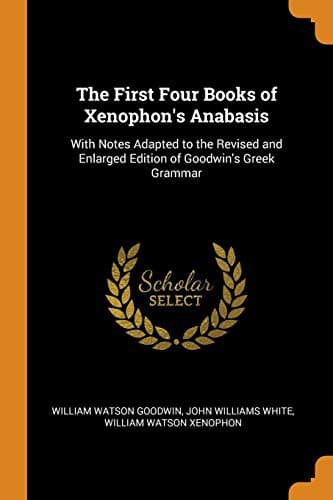
The First Four Books of Xenophon's AnabasisXenophon
History
The First Four Books of Xenophon's Anabasis
Xenophon
Cyrus, the Younger, approximately 423 B.C.-401 B.C.; Iran -- History -- To 640
15. At this juncture Cyrus came up, and inquired into the affair. He
then instantly took his javelins in his hand, and rode, with such of his
confidential officers as were with him, into the midst of the Greeks,
and addressed them thus: 16. "Clearchus and Proxenus, and you other
Greeks who are here present, you know not what you are doing. For if you
engage in any contention with one another, be assured, that this very
day I shall be cut off, and you also not long after me; since, if our
affairs go ill, all these Barbarians, whom you see before you, will
prove more dangerous enemies to us than even those who are with the
king." 17. Clearchus, on hearing these remonstrances, recovered his
self-possession; and both parties, desisting from the strife, deposited
their arms in their respective encampments.
[Footnote 44: Απεσπᾶτο.] "Drew itself away from" its pursuers. There are
various readings of this word. Kühner adopts ἀπεσπα, in the sense of
"drew off its pursuers from the rest of the huntsmen." Bornemann reads
ἀπέπτατο.]
[Footnote 45: It would be needless to repeat all that has been said as
to the construction of this passage; I have adopted the explication of
Kühner.]
[Footnote 46: Επὶ Πύλας.] A strait or defile through which the road lay
from Mesopotamia into Babylonia; hence called the _Pylæ Babyloniæ_. It
is mentioned by Stephanus Byzantinus _sub voce_ Χαρμάνδη. Ainsworth, p.
80, places it fourteen miles north of Felújah, and a hundred and eight
miles north of Babylon.]
[Footnote 47: Καπίθη.] A measure, as is said below, equal to two Attic
_chœnices_. The Attic chœnix is valued by Mr. Hussey, Essay on Ancient
Weights, &c., ch. 13, sect. 4, at 1.8467 pint.]
[Footnote 48: The _siglus_ is regarded by some as the same with the
Hebrew shekel, but erroneously, as the siglus was of less value than the
shekel. The obolus is valued by Mr. Hussey at something more than three
half-pence; seven oboli and a half would therefore be about a shilling.]
[Footnote 49: Σκεπάσματα is the reading of Dindorf, but it ought rather
to be στεγάσματα, if the distinction of Krüger and Kühner, who adopt the
latter, be right; viz. that στίπασμα signifies a covering to wrap round
the body, and στέγασμα a shelter against sun or rain. See Arrian, iii.
29. This mode of crossing rivers, we learn from Dr. Layard, is still
practised in Armenia both by men and women.]
[Footnote 50: See note on i. 2. 22.]
CHAPTER VI.
Traces of the king's troops are perceived. Orontes, a Persian
nobleman, a relation of Cyrus, offers to go forward with a body of
cavalry, and lay an ambush for the king's army. Before he sets out,
however, he is found to be in correspondence with the king, and is
put to death.
Public-domain text, read in full here on John Shaqi.
Reviews
Reviews
No reviews yet
Be the first to share your thoughts on this work.
Join the Discussion
Join the discussion
Sign in to leave a comment or review.
Sign InorCreate an account