The First Four Books of Xenophon's Anabasis — John Shaqi
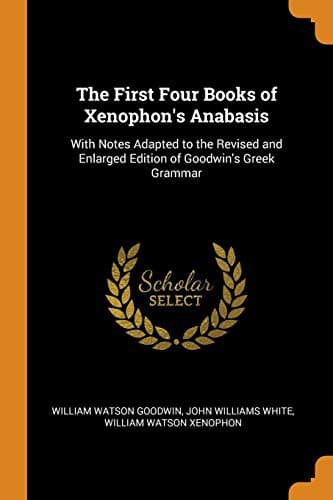
The First Four Books of Xenophon's AnabasisXenophon
History
The First Four Books of Xenophon's Anabasis
Xenophon
Cyrus, the Younger, approximately 423 B.C.-401 B.C.; Iran -- History -- To 640
[Footnote 74: Ἀναπτύσσειν.] Literally "to fold back." Whether we are to
understand that one part of the wing was drawn behind the other, is not
very clear. The commentators are not all agreed as to the exact sense
that the word ought to bear. Some would interpret it by _explicare_, "to
open out," or "extend," and this indeed seems more applicable to
περιπτύξαντες which precedes; for the Greeks might lengthen out their
line that the king's troops might not surround them. But on the whole,
the other interpretation seems to have most voices in favour of it.]
[Footnote 75: Ἐκ πλέονος.] Sc. διαστήματος: they began to flee when the
Greeks were at a still greater distance than before.]
[Footnote 76: Μέχρι κώμης τινός.] This is generally supposed to have
been Cunaxa, where, according to Plutarch, the battle was fought.
Ainsworth, p. 244, identifies Cunaxa with _Imséy'ab_, a place 36 miles
north of Babylon.]
[Footnote 77: The infantry seem to have fled; the cavalry only were
left.]
[Footnote 78: Ἐπὶ πέλτης ἐπὶ ξύλου.] So stands the passage in Dindorf's
text; but most editors, from Schneider downwards, consider ἐπὶ ξύλου to
be a mere interpretation of ἐπὶ πέλτης, that has crept by some accident
into the text, and either enclose it in brackets or wholly omit it.
Πέλτη is said by Hesychius and Suidas to be the same as δόρυ or λόγχη:
and Krüger refers to Philostratus, Icon. ii. 82, ἐπὶ τῆς πέλτης ἀετός.
In Cyrop. vii. 1, 4, the insigne of Cyrus the elder is said to have been
a golden eagle, ἐπὶ δόρατος μακροῦ ἀνατεταμένος. Πέλτη accordingly being
taken in this sense, all is clear, and ἐπὶ ξύλου is superfluous. Kühner
gives great praise to the conjecture of Hutchinson, ἐπὶ πέλτης ἐπὶ
ξυστοῦ, who, taking πέλτη in the sense of _a shield_, supposed that the
eagle was mounted on a shield, and the shield on a spear. But the shield
would surely have been a mere encumbrance, and we had better be rid of
it. Yet to take πέλτη in the sense of _a spear_, unusual in Xenophon, is
not altogether satisfactory; and it would be well if we could fairly
admit into the text Leunclavius's conjecture, ἐπὶ παλτοῦ.]
[Footnote 79: Ἀνατεταμένον.] This word is generally understood to
signify that the eagle's wings were expanded. See Liddell and Scott's
Lexicon; and Dr. Smith's Dict. of G. and R. Ant. sub _Signa
Militaria_.]
BOOK II.
CHAPTER I.
The Greeks are surprised to hear of the death of Cyrus. Ariæus
resolves to return to Ionia, contrary to the advice of Clearchus,
who incites him to make an attempt on the throne of Persia.
Artaxerxes sends a message to the Greeks; their reply.
Public-domain text, read in full here on John Shaqi.
Reviews
Reviews
No reviews yet
Be the first to share your thoughts on this work.
Join the Discussion
Join the discussion
Sign in to leave a comment or review.
Sign InorCreate an account