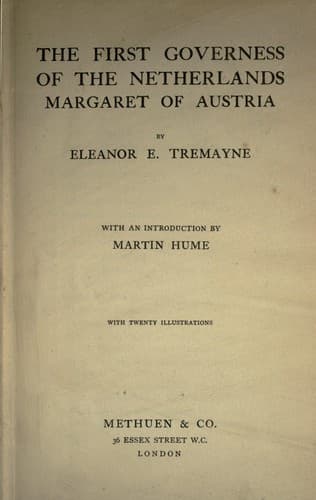
The First Governess of the Netherlands, Margaret of AustriaTremayne, Eleanor E.
History
The First Governess of the Netherlands, Margaret of Austria
Tremayne, Eleanor E.
Margaret, of Austria, Regent of the Netherlands, 1480-1530; Netherlands -- History -- Charles V, 1506-1555
Maximilian replied that he has written to Charles, and encloses a copy
of the letter, in which he says: 'We make no doubt, because of the
honour and love you owe to our very dear daughter, your aunt, that you
communicate your chief and most arduous business to her, and that you
take and use her good advice and counsel, from which, for natural
reasons, you will always find more comfort, help, and support than
from any other. In which, as a royal father, we exhort you always to
continue, begging you affectionately to remember the way she laboured
during your minority in the administration of your country... and
also that you are her whole heart, hope, and heir,--that you will
give her a good allowance, such as she has had until now... for she
has well deserved it from you.'
On August the 20th, 1515, Margaret presented a memorandum to her
nephew before the assembled Council containing a justification of her
government, which began thus: 'Monseigneur, as I evidently perceive,
after having had such long patience, that by divers means they try to
give you suspicions of me, your humble aunt, to withdraw me from your
goodwill and confidence, which would indeed be a poor recompense for
the services which I have rendered you until now, I am constrained to
excuse myself....' She bitterly complains of the way she has been put
aside, and protests against the calumnies brought against her. To
justify her conduct, she recalls her services during Charles's
minority, and firmly maintains that she always acted uprightly and
loyally without any profit to herself, serving the prince from love,
without any thought of gain. If any error should be found in the
detailed account presented to the Council, she requests that it may be
pointed out to her before the prince, so that she can answer it
herself, for 'I prefer,' she says, 'that they should speak before me,
than behind my back.' She then relates all the principal acts of her
government, from the time the emperor first confided the regency to
her care, and recalls her long struggles with the Duke of Gueldres,
who, aided and abetted by the King of France, broke all treaties, and
feared neither God nor man; and recounts the part she played in the
alliance with England, and also at the Treaty of Cambray, which was
only brought to a successful issue after much pain and trouble. She
indignantly denies that she has been the cause of renewed wars with
Gueldres, for far from seeking war, she has ever striven for peace.
'And what has been the reward of all this service and sacrifice?' From
the time of her appointment as regent she has given her time and money
for her nephew's service, without touching a 'denier,' and spent more
than three thousand florins from her own income. The prince's proposed
emancipation was kept from her, though had her advice been asked she
would not have opposed it; her opinion was no longer asked, and
through calumnious imputations it was tried to injure her with her
nephew.
Public-domain text, read in full here on John Shaqi.
Reviews
Reviews
No reviews yet
Be the first to share your thoughts on this work.
Elsewhere in the archive
Join the Discussion
Join the discussion
Sign in to leave a comment or review.
Sign InorCreate an account