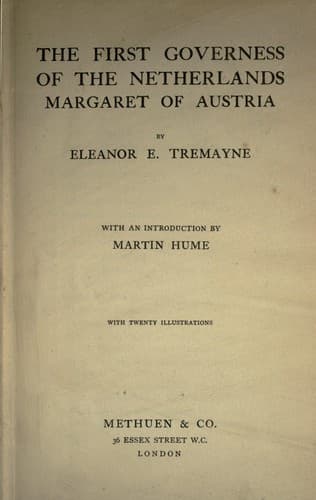
The First Governess of the Netherlands, Margaret of AustriaTremayne, Eleanor E.
History
The First Governess of the Netherlands, Margaret of Austria
Tremayne, Eleanor E.
Margaret, of Austria, Regent of the Netherlands, 1480-1530; Netherlands -- History -- Charles V, 1506-1555
M. Tailliar gives an interesting account of the young archduke's state
entry into Douay, accompanied by Margaret: 'On the 15th of May 1516
Charles, King of Spain and Count of Flanders, having made his joyous
entry into Douay, went next day, the 16th, to the market-hall to
receive the oaths of fealty. The square in front of the hall was
richly hung with velvet and cloth of gold. After hearing mass, the
king appeared, accompanied by his aunt, Madame Margaret of Austria,
and by his eldest sister, Madame. He took the oath in the prescribed
manner, and likewise all those present swore fealty to him.'
King Ferdinand of Aragon had died on the 23rd of January 1516. By his
will, Charles was excluded from the kingdom of Aragon, which was left
to his younger brother, Ferdinand, who had been the old king's
favourite; but in his last moments, repenting perhaps of this unjust
arrangement, he made a codicil, in which he not only left Charles heir
to all his estates, but also made him Grand Master of the Military
Orders, leaving Ferdinand with a pension of 50,000 ducats a year.
Although Queen Joanna was still alive, Charles assumed the title of
King, and was first proclaimed Sovereign of Castile and Aragon,
conjointly with his mother, at Brussels, where Ferdinand's funeral
obsequies were celebrated in the cathedral of St. Gudule. 'Twice the
king-at-arms of the Golden Fleece called aloud, "Don Ferdinand." Twice
the answer came, "He is dead," and on this the great standard
clattered to the ground. Then cried the herald, "Long live donna
Jehanne and don Charles, by the grace of God Catholic kings," whereon
Charles, doffing his mourning, received and brandished the sword of
justice.'[52]
[52] Armstrong, _The Emperor Charles V._
In Spain this assumption of the royal title was regarded as a breach
of custom, and caused comment and discontent. Nevertheless Cardinal
Ximenes had his young master proclaimed in Castile. The regency of
Castile had been intrusted to him by Ferdinand until Charles's
arrival, and that of Aragon to the late king's natural son, the
Archbishop of Saragossa.
Public-domain text, read in full here on John Shaqi.
Reviews
Reviews
No reviews yet
Be the first to share your thoughts on this work.
Elsewhere in the archive
Join the Discussion
Join the discussion
Sign in to leave a comment or review.
Sign InorCreate an account