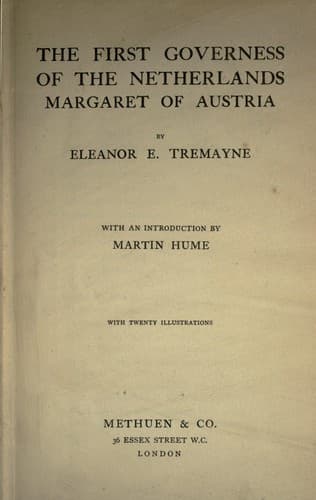
The First Governess of the Netherlands, Margaret of AustriaTremayne, Eleanor E.
History
The First Governess of the Netherlands, Margaret of Austria
Tremayne, Eleanor E.
Margaret, of Austria, Regent of the Netherlands, 1480-1530; Netherlands -- History -- Charles V, 1506-1555
Before Charles succeeded to his Spanish kingdoms, his sister Mary had
already left home for her short, though comparatively happy, marriage
with the ill-fated Louis of Hungary, while Isabella had begun her
miserable life with the brutal and licentious Christian II. of
Denmark. His brother Ferdinand and his youngest sister Katharine were
being brought up in Spain. Only Charles's eldest sister Eleanor
remained at Brussels. About this time she seems to have had a rather
serious flirtation with the handsome Count Palatine Frederick, who was
the most accomplished nobleman of the Court, and though seventeen
years his senior, Charles's earliest personal friend. The affection
between the count and Eleanor was mutual, and led to clandestine
correspondence. Chièvres set Charles on the track of one of the
count's love-letters. Pretending to wish his sister good-morning, he
snatched it from her bosom before she had time to read it, and after a
brief scrimmage secured the prize. 'Upon this his constancy into a
like affair,' wrote Spinelli to Henry VIII., 'many do conject in him
good stomak and couraggy, and how he will be fast in his
determjnacions, and much extime the honnor of the worlde.' This
singularly sound forecast of the character of the hitherto problematic
boy of sixteen gives, perhaps, the first glimpse of his
personality.[53]
[53] E. Armstrong.
Educated by the courtly William de Croy, Lord of Chièvres, with
Adrian of Utrecht as preceptor, Charles developed manners and
characteristics, half patrician, half plebeian, which was probably due
to his tutors' opposite influences. De Croy's courteous manners gave
him a stately bearing, reserve, and dignity which subsequently
attached him to the Spaniards; while from Adrian he acquired the
popular, easy-going and simple ways which made him so beloved by his
Flemish subjects.
[Illustration: CHARLES V
FROM THE PAINTING IN THE LOUVRE (FLEMISH SCHOOL)]
His intellectual faculties did not develop early--he even showed
marked aversion for science and letters, and preferred military
exercises to the study of government. De Chièvres, however, made him
study the history not only of his own kingdoms, but of those with
which they were connected. He accustomed him, from the time of his
assuming the government of Flanders, to attend to business, and
persuaded him to read all papers relating to public affairs, to be
present at the deliberations of his privy-councillors, and to propose
to them himself those matters concerning which he required their
opinion. From such an education Charles contracted habits of gravity
and recollection which scarcely suited his youth. The first openings
of his genius did not show that superiority which its maturer age
displayed.[54]
[54] Prescott.
Public-domain text, read in full here on John Shaqi.
Reviews
Reviews
No reviews yet
Be the first to share your thoughts on this work.
Elsewhere in the archive
Join the Discussion
Join the discussion
Sign in to leave a comment or review.
Sign InorCreate an account