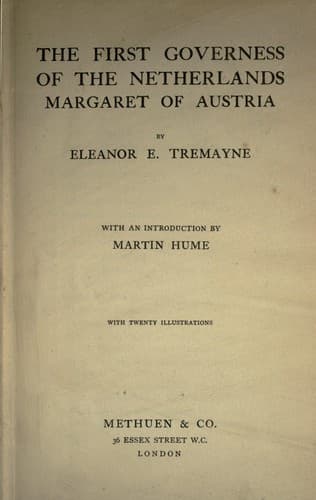
The First Governess of the Netherlands, Margaret of AustriaTremayne, Eleanor E.
History
The First Governess of the Netherlands, Margaret of Austria
Tremayne, Eleanor E.
Margaret, of Austria, Regent of the Netherlands, 1480-1530; Netherlands -- History -- Charles V, 1506-1555
Maximilian was twice married; first, to Mary of Burgundy, through whom
he became possessed of the vast domains of that house; and secondly,
to Bianca Sforza, daughter of the Duke of Milan, by whom he had no
children. Of a kindly and chivalrous nature and endowed with many good
qualities, Maximilian was popular amongst his subjects, but obtained
little esteem from his contemporaries, owing to a radical inconstancy
and indecision of temper, and an extravagance which involved him in
perpetual pecuniary embarrassments. Margaret was not present at her
father's death, but no one felt his loss more keenly than she did, for
he had ever shown himself an affectionate and devoted parent, and
though so often parted, their intercourse had been, as their
correspondence proves, of the closest and most intimate kind. Her
grief found vent in a long poem or lament, in which she enumerates her
many sorrows:
'.... O mort trop oultrageuse!
Tu a estain la fleur chevaleureuse
Et as vaincu celluy qui fust vainqueur,
Maximilien, ce très-noble Empereur,
Qui en bonté à nul ne se compère.
C'estoy César, mon seul seigneur et père,
Mais tu l'as mis en trop piteux estat,
Sépulturé au chasteau Nieustat....'[61]
[61] 'Complainte de Marguerite sur la mort de Maximilien son
père' (_Albums de Marguerite d'Autriche_, p. 101).
Amongst the condolences which she received there is an interesting
joint-letter in Latin from Anne of Hungary (who was betrothed to
Ferdinand of Austria), and from Ferdinand's sister Mary (affianced to
Louis of Hungary). The letter is written from Innsbrück on the 22nd of
January and signed by both princesses.
Maximilian did much to improve his country, and greatly encouraged art
and learning. He especially favoured the universities of Vienna and
Ingoldstadt, and caused at least two works to be written under his own
personal direction--_Theuerdank_ in verse, and _Weiss Künig_ in
prose--in both of which he figures as the hero. He also rendered an
important service to Germany by abolishing the famous secret tribunal
of Westphalia.
Public-domain text, read in full here on John Shaqi.
Reviews
Reviews
No reviews yet
Be the first to share your thoughts on this work.
Elsewhere in the archive
Join the Discussion
Join the discussion
Sign in to leave a comment or review.
Sign InorCreate an account