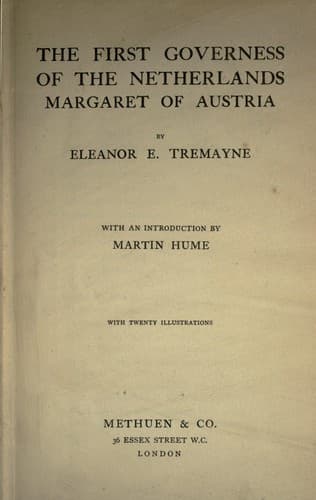
The First Governess of the Netherlands, Margaret of AustriaTremayne, Eleanor E.
History
The First Governess of the Netherlands, Margaret of Austria
Tremayne, Eleanor E.
Margaret, of Austria, Regent of the Netherlands, 1480-1530; Netherlands -- History -- Charles V, 1506-1555
Charles was on his way to Barcelona when he received the news of his
grandfather's death. Deputing Adrian of Utrecht to hold the Cortes of
Valencia, he hurried from Barcelona to Corunna on the Galician coast,
intending to set sail for his new kingdom. His appointment of Adrian
as sole regent was the crowning insult to Spanish feelings; the
Cardinal had little experience and less ability; above all he was of
low birth and a foreigner, and the king had promised to bestow no
office on 'those who were not natives of the kingdom.' Besides, a
Cortes had been summoned to meet at Santiago in Galicia, outside
Castile, and the Castilians felt deeply injured. Discontent was rife
on all sides, and many wild rumours were afloat. It availed little
that Charles in his broken Spanish promised to return in three years.
The deputies were not mollified, and demurred to granting the desired
subsidy, which was only reluctantly voted. Charles excused his hurried
departure from Spain on the plea of his obligation to attend to his
new dominions, but this excuse did not pacify his discontented
subjects, who foresaw the misery of his prolonged absence, with a
hated foreigner as regent.
Maximilian's death revived Francis I.'s hopes of gaining the
much-coveted imperial crown, for he was not long in recognising the
equivocal and expectant attitude of the electors who had formally
promised their votes to the dead emperor. He now entered the lists as
Charles's rival, and tried to gain over the electors by every means in
his power.
Margaret was in despair at the apparent small chance of her nephew's
success, and with the advice of her Council prepared to send the
Archduke Ferdinand into Germany to look after his brother's interests,
and suggested that Charles should waive his claim in favour of
Ferdinand, whose candidature would be less likely to be opposed by the
Pope and the German princes.
But Charles was as adamant, and indignantly rejected this proposal,
asserting that it had been his grandfather's wish that he alone should
succeed to the imperial dignities, and for this end the electors had
promised him their votes. If Ferdinand was chosen, the empire would be
weakened, and the House of Austria divided, to the gratification of
his enemies. 'He alone,' he haughtily said, 'ought to be emperor in
order to uphold the splendour of his House, and realise the great
designs he had conceived for the good of Christianity. Should our
person be elected, as is reasonable from what has gone before, we
could carry out many good and great plans, and not only preserve and
keep the dominions that God has given us, but greatly increase them,
by giving peace, repose, and tranquillity to all Christendom, in
exalting and upholding our holy Catholic faith which is our chief
foundation....'[62]
[62] M. Théodore Juste, _Charles-Quint et Marguerite d'Autriche_.
Public-domain text, read in full here on John Shaqi.
Reviews
Reviews
No reviews yet
Be the first to share your thoughts on this work.
Elsewhere in the archive
Join the Discussion
Join the discussion
Sign in to leave a comment or review.
Sign InorCreate an account