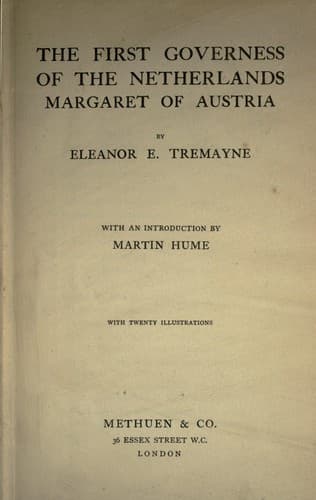
The First Governess of the Netherlands, Margaret of AustriaTremayne, Eleanor E.
History
The First Governess of the Netherlands, Margaret of Austria
Tremayne, Eleanor E.
Margaret, of Austria, Regent of the Netherlands, 1480-1530; Netherlands -- History -- Charles V, 1506-1555
Margaret hastened to justify her conduct in a letter to Charles on the
21st of March, in which she said that when the news of Maximilian's
illness reached the Netherlands, the Council had judged it wiser to
send Ferdinand to Germany to watch over Charles's hereditary domains,
but that the archduke would yield to his brother's wishes, 'for,' she
added, 'one could not see a better or more debonair prince of his
age.'
As matters turned out, Charles's determination was fully justified,
for Francis's methods had not proved successful, and had only
alienated him from some of his most powerful supporters. The
condottiere, Franz von Sickingen, the Duke of Bouillon, and his
brother Érard de la Marck, Bishop of Liége, offended by Francis's
treatment of them, went over to the Court of Brussels and upheld the
interest of the Spanish king.
The rivalry which from henceforth existed between the two young
monarchs promised ere long to break the friendly relations with which
Charles's reign began, but Margaret with her usual diplomacy saw the
danger of a rupture with France at such a moment, and strongly advised
Charles to keep on good terms with his rival. Acting on this wise
advice, when Robert de la Marck left France and joined the Court at
Brussels, Charles's ambassadors hastened to assure the French king
that their master had taken no part in Robert's defalcation, and to
support their assertion proposed that Charles should marry Francis's
youngest daughter, Princess Charlotte, which offer was very well
received.
To get an idea of the activity and political talents Margaret
displayed in connection with Charles's election one must read her
correspondence with Frederick, Count Palatine, Maximilian de Berghes,
Henry of Nassau, her treasurer Marnix, the Cardinals of Sion and
Gurce, John de la Saulx, and Gérard de Pleine, and glance through her
accounts and receipts, which show what enormous sums were spent in
presents, bribes, pensions, and salaries on all those who were likely
to contribute to the desired end. The Archbishops of Cologne, Mayence,
and Trèves, and their councillors received between them nearly five
hundred florins in gold. In these curious accounts large sums appeared
to have been lavished not only on the principal negotiators, but on
their relations, friends, and servants. Thus five hundred florins are
given to the Archbishop of Trèves' nephew, a hundred to the Cardinal
of Mayence's valet-de-chambre, and a present of two thousand florins
is promised to Count John, the elector of Cologne's brother, who is
supposed to have more influence than the elector himself.[63]
[63] These documents are amongst the archives of Lille.
Public-domain text, read in full here on John Shaqi.
Reviews
Reviews
No reviews yet
Be the first to share your thoughts on this work.
Elsewhere in the archive
Join the Discussion
Join the discussion
Sign in to leave a comment or review.
Sign InorCreate an account